A Biography of the First Hawaiian Statesman
By Constance Kiakahi Hale
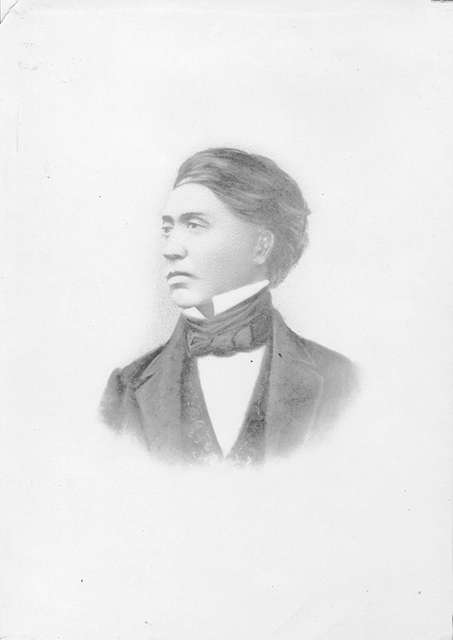
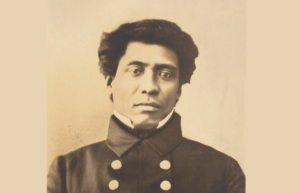
Kamalehua Haʻalilio was born in 1808 in Koʻolaupoko, the windward coastal area on O‘ahu that stretches from from Makapuʻu Point to Kaʻōʻio Point at the northern end of Kane‘ohe Bay. His parents—father Kōʻeleʻele and mother Kipa—were aliʻi, according the family stature and respect. After his father died, when he was quite young, his mother, also known as ‘Eseta (or Esther) Kipa, married the Governor of Molokaʻi, and after his death, she acted as Governess for fifteen years. Her son grew up in a world where loss and responsibility were braided together, enlivened by a lineage of authority.
This was enhanced when, at 8, Haʻalilio was taken to Hilo and folded into the household of the young prince Kauikeaouli—later Kamehameha III. The two boys grew up together, one destined for kingship, the other for service that evolved into statecraft and profound patriotism. By age 13, Haʻalilio and Kauikeaouli were among the first Hawaiians chosen to study with Protestant missionaries, including Hiram Bingham, who noted Haʻalilio’s “naturally good powers of mind” and “aptitude to learn.” Haʻalilio took the Christian name Timothy, transliterated as Timoteo. (Bingham is cited in an article by Hilinaʻiikaponoaupunioumialiloa Sai-Dudiot.)
Education, for Haʻalilio, was a tool sharpened in proximity to power. He learned English alongside Hawaiian, practiced arithmetic and penmanship, and soon found himself writing for the king—not yet secretary, but already indispensable. It was a quiet apprenticeship in governance that trained him to carry the weight of a kingdom’s voice. In time, his responsibilities deepened: he became steward of the king’s private purse, observer of mercantile detail, and student of political change. His systematic and extremely careful temperament were habits that shaped his role in his nation’s emerging government.
By his late teens, Haʻalilio had entered adulthood with both a familiarity with power and a remove from it. In 1826, he married Hanna Hooper, or Hana Hopua, the daughter of an American father; it was a union emblematic of a kingdom in transition. Five years later, when the Lahainaluna School was founded, he continued his education there, moving through the curriculum and through court society with increasing ease. Observers described as possessing “a frank, pleasant countenance and good manners,” dressed in European fashion yet grounded in Hawaiian allegiance. (The quote is from Mary Ellen Birkett’s article “French Perspective on the Laplace Affair” in the Hawaiian Journal of History, vol. 32)
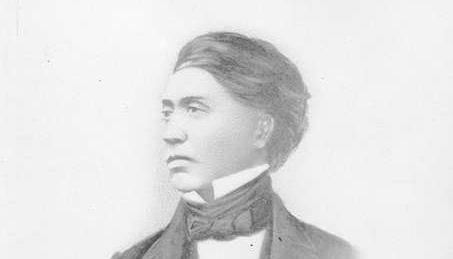
Haʻalilio’s political ascent coincided with the transformation of the Hawaiian Kingdom itself. A member of the first House of Nobles under the 1840 Constitution, he was also a founding figure in the Hawaiian Historical Society, gathering the past even as he helped invent the future. He was also a member of the hulumanu (bird feathers), a group of often flamboyant favorites of King Kamehameha III. In his official role, he advocated for constitutional governance, understanding “the practical influence of the former system” and the necessity of change for “the welfare of the nation.” In him, intellect and patriotism fused: an article from the Kamehameha Schools remembers him as “faithful to the Lord and loyal to his ʻohana, to his aliʻi and to our lāhui.”
In April 1842, King Kamehameha III entrusted Haʻalilio with a mission that would secure his legacy. The king appointed Haʻalilio as the kingdom’s first diplomat, alongside William Richards, a missionary-turned-teacher-and-trusted-friend. (By then Richards was special counsel to the king.) The two were charged with persuading the great powers—Britain, France, and the United States—to recognize Hawaiʻi’s sovereignty. Haʻalilio’s initial response, remembered in oral accounts, was a plea: “Please don’t ask this of me. Ask me anything, but not this.” Kamehameha III is said to have replied, “There is no one I trust more with the welfare of our country than you.” With that, Haʻalilio accepted the commission. He stepped into history, his reluctance soon transmuted into resolve.
The diplomatc journey itself was an ordeal: across the Pacific, overland through Mexico, and into the racial hierarchies of Washington, D.C., where he was mistaken for a servant and denied a seat at table despite his rank as envoy. Still, he persisted. In London, Paris, and Brussels, he moved among ministers and monarchs, securing audiences that culminated in the 1843 Anglo-French declaration recognizing Hawaiian independence. Observers noted that in every circle he entered, “he never failed to secure entire respect,” his dignity enlarging the stature of the kingdom he represented.
Yet even as he carried the sovereignty of Hawaiʻi into the courts of empire, Haʻalilio’s private writings reveal a man tethered to faith and longing. Puakea Nogelmeier has translated a letter to Richards while the two were separated in Europe. Haʻalilio wrote:
“Our feet have been safe as we travel and reside upon these unfamiliar lands. However, our safety is not through the goodness and intelligence of man, nor is the good outcome of the work for which we came, or our physical health as we travel these friendless lands; it is the holy one who has taken care of you and I and those we left behind….
“My health is good these days, and … I am comfortable. I am, however, sad for us, because of our being apart, but I am taking care of myself through all trials of the body and spirit. I look to the lamb of God, who absolves our misfortunes.”
A letter to his mother is similarly threaded with humility and devotion. (It is also translated by Nogelmeier.) After much illness abroad, he broaches the subject of death with tenderness:
“If my life should end following this letter of mine to you, my mother, then we may not see each other again. But if a time for us still remains, then, my beloved mother, we shall be blessed to see each other alive and in person. Listen, dear mother, here I am, your child, the eldest of the first time you experienced such pain and peril. … That you may have great endurance and abide with great patience. If the Lord reserves more time for us, then we shall be blessed to meet again with love and joy.”
He signed off: Aloha nui kāua. E ola kāua i ka Haku. (Great love for both of us. May the Lord save us both.)
Haʻalilio’s letters (cited in an article by Kamehemeha Schools), are luminous with vulnerability; they show a diplomat whose inner life was as fervent as his public duty. And yet that was not enough to forestall tragedy.
After years of travel through harsh climates and repeated illness, Haʻalilio succumbed to what was likely tuberculosis. On December 3, 1844, aboard the ship Montreal off the coast of New York, on his way back to his beloved homeland, Haʻalilio died. He was 36. And he was successful, having completed the work that would outlive him. In his final hours he is said to have whispered, “My work is done. I am ready to go.”
When news reached Honolulu, the kingdom mourned: chiefs wept, flags fell to half-mast, and a nation felt the absence of the man who had proudly carried its name across the world.