In Kamalehua, the first-ever opera in ‘ōlelo Hawai‘i, an all-star team of creatives and performers bring to life the tragic and inspiring tale of Timoteo Ha‘alilio.
By Constance Kiakahi Hale
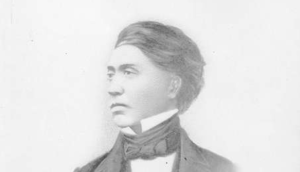
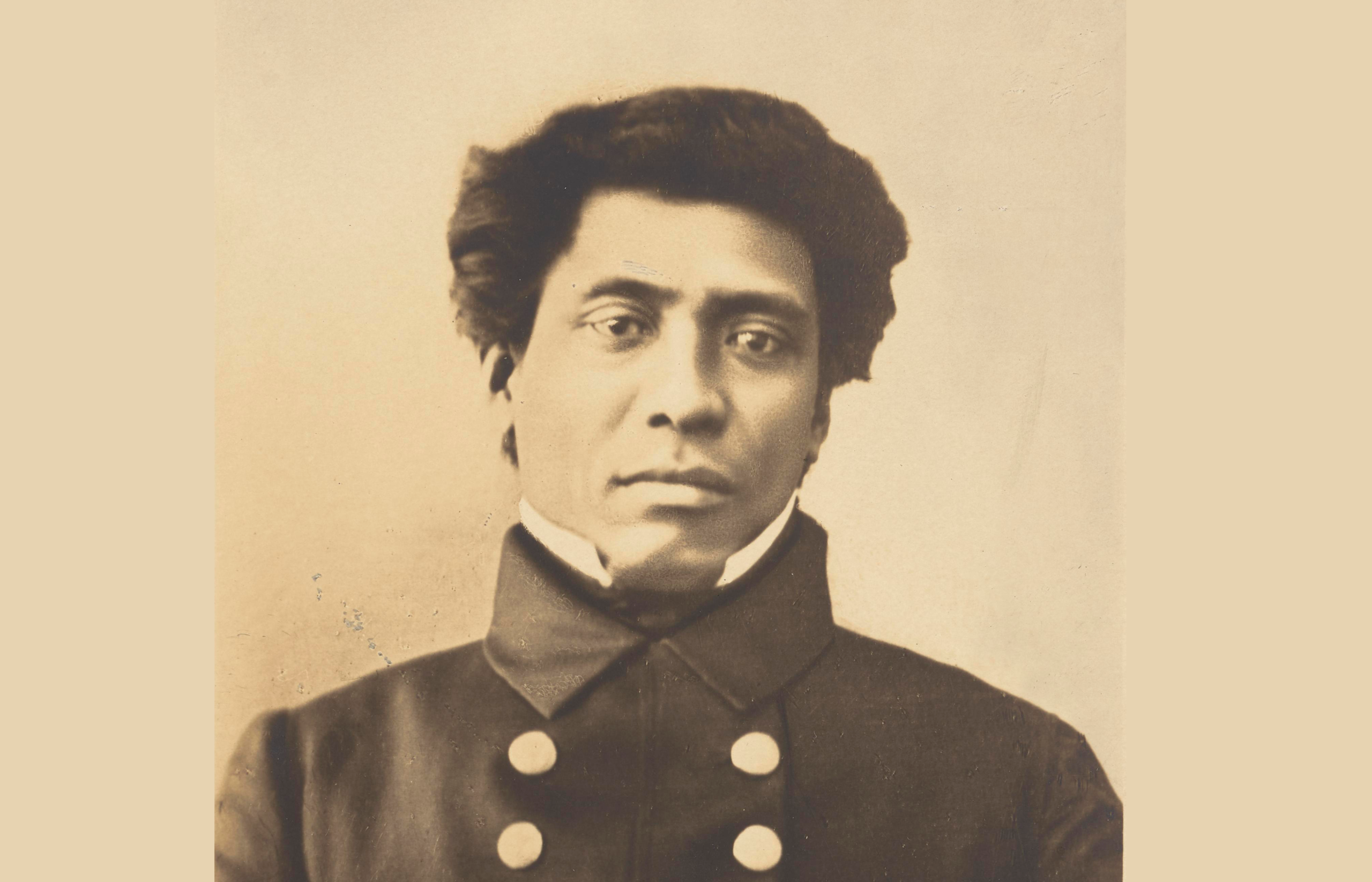
Come to hula class on a random weeknight on Potrero Hill, and you’ll witness the vast and vivid T-shirt collection of Kumu Patrick Makuakāne. There is “got poi?” and a vintage Bruce Lee that reads “Jeet Kundo” and “Nuuanu-Pauahi” and even one with a portrait of Jesus and the words “You guys, I never said any of that!” But one of the dance master’s favorite T’s features a photo of a handsome 19th century Hawaiian, his striking face framed by the high collar of a gold-buttoned jacket and a shock of thick, wavy hair.
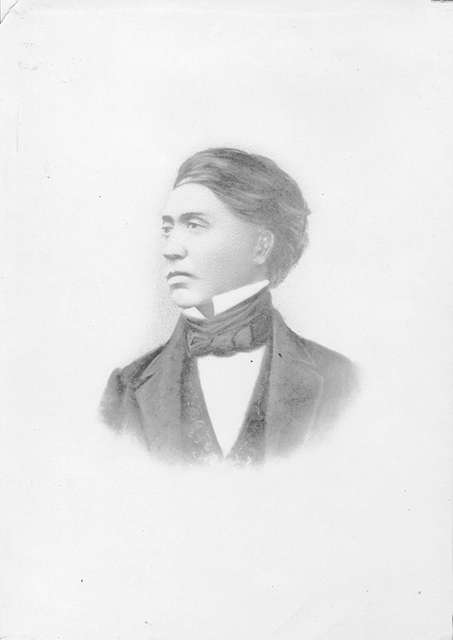
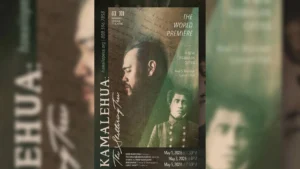
This is Timoteo Kamalehua Ha‘alilio, an unsung hero of the Hawaiian Kingdom. Unsung, that is, until May 1, 2026, when the first major opera ever in ‘ōlelo Hawai‘i will literally sing his praises. Kamalehua: The Sheltering Tree débuts in Honolulu, telling the story of an ali‘i of stature and reputation, a confidante to a king, a diplomat to the United States and Europe, and a statesman of both deep erudition and deep humility.
The idea for an opera about Ha‘alilio originated when Kumu Patrick was approached by Andrew Morgan, the head of Hawaiʻi Opera Theatre.
Before he was appointed general director of the island opera company in May 2019, Morgan had spent eleven years at the San Francisco Opera. (Earlier in his career, he had served as executive director for American Bach Soloists in San Francisco, and with the men’s a cappella ensemble Chanticleer, and he had appeared as a tenor with numerous Bay Area ensembles.)
No sooner did Morgan arrive in Honolulu than he started fretting over the fact that the company’s repertoire was completely Euro-centric. During his years in San Francisco, Morgan had become familiar with Nā Lei Hulu i ka Wēkiu and the work of Kumu Patrick Makuakāne, so he reached out to the hula master to see if he might be interested in directing a new work.
“Opera is not my favorite medium,” said Kumu Patrick with a hint of his trademark humor. He quickly added that he appreciates “its uniqueness,” but he is, after all, a one-time habitué of gay clubs, a former DJ, and a choreographer who introduced electronic music to the hula stage. Not that he hadn’t choreographed hula to an aria; in fact, “Flower Duet” (from Léo Delibes’ 1883 opera Lakmé) is one of his signature works. But, really, direct an opera?
As Kumu Patrick started mulling the idea, a few things excited him, especially the fact that Morgan was working with Herb Mahelona, a choir director at Kamehameha Schools who takes his students to festivals in Europe. In 2019, Mahelona’s wards performed The Battle of Kuamoʻo, an opera sung entirely in ‘ōlelo Hawai‘i, at Scotland’s Edinburgh Festival Fringe, the world’s largest performing arts festival. Needless to say, Kumu Patrick recognized a kindred spirit.
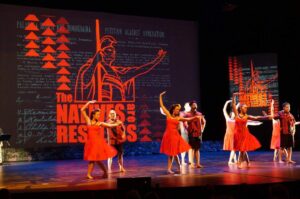
“Andrew said to me, ‘We can use Herb’s opera, or we can use an idea of yours,’” Kumu Patrick remembers. The invitation was catnip. For years he had been mulling the story of Timoteo Ha‘alilio, the only man King Kamehameha III trusted to be his emissary to Europe and the US. His sometime collaborator Kau‘i Sai-Dudoit had made him aware of Ha‘alilio, but apart from a segment in the 2017 Hawai‘i version of The Natives Are Restless, Kumu Patrick had not had occasion to pay this man greater tribute.
The more Kumu Patrick thought of it, the better the idea seemed. For starters, Haʻalilio was one of the closest childhood friends of Kamehameha III (born Kauikeaouli), and he was someone whose life embodied all the promise and problems of the king’s reign. And Ha‘alilio’s biography made for a larger-than-life drama that inspires awe and spells tragedy—just the stuff of opera. On top of that, Kumu Patrick said emphatically, “No one even knows this incredible story!”
For the full biography of Timoteo Kamalehua Ha‘alilio, including accounts of conversations with his king and letters to loved ones, please see “Timoteo Kamalehua Haʻalilio: A Biography of the First Hawaiian Statesman,” also on this website.
To convince Morgan and Mahelona of his idea, Kumu Patrick scheduled a Zoom meeting and invited Kau‘i Sai-Dudoit. “As soon as she finished telling the story of Ha‘alilio,” he says, “both Andrew and Herb said, ‘This is it. We are doing this story.’”
After enlisting Kumu Patrick to direct and Mahelona to write the score, Morgan reached out to Victoria Nalani Kneubuhl to write the libretto. The Hawaiian-Samoan playwright and novelist has made a habit of bringing the past to the present, not just in more than two dozen plays like Ola Nā Iwi, but also in short stories and novels. She has been recognized twice with the Elliott Cades Award, also known as the Hawaiʻi Award for Literature.
The opera they created, Kamalehua: The Sheltering Tree, is set in the middle of the nineteenth century and reveals the little-known history of the Hawaiian Kingdom and its early struggles to maintain independence. Timoteo Haʻalilio is the central character, in his role as Royal Secretary and the kingdom’s first diplomat. Specifically, the opera focuses on Haʻalilio’s 1842-45 mission to the United States, Great Britain, Belgium, and France to secure treaties recognizing Hawaiʻi as a sovereign nation. His ultimate charge was to protect the kingdom from annexation by foreigners. He succeeded on all levels, witnessing the signing of the Anglo-French Proclamation on November 28, 1843. But the long trip had wreaked havoc on his health, and he died, probably of tuberculosis, onboard the ship home to his beloved Hawaiʻi.
To embody this historic figure, one more superstar joined the creative team: the celebrated Hawaiian baritone Quinn Kamakanalani Kelsey. Kelsey began performing opera in 1991 when he was a 13-year-old chorus member of the Hawaiʻi Opera Theatre. Since then, he has performed the title roles in Rigoletto and Macbeth, as well as the roles of Scarpia in Tosca, and Germont in La Traviata. He has been featured in leading roles at the Metropolitan Opera in New York City, the San Francisco Opera, and other major opera companies in America and Europe. Kelsey has beendescribed as “glamorous and persuasive” by Zachary Woolfe of The New York Times, “his roomy voice smoky, with bronzed tenorial resonances as its rises.”
For a man who is already an international star as a leading man, Kamalehua offers Kelsey a new accomplishment: the first leading man to sing in ‘ōlelo Hawai‘i.
Both the opera’s creators and its performers were helped by Ha‘alilio’s own words, including his reluctant agreement when the king implored him to go on the journey, his eloquent letter to William Armstrong, his trusted friend and fellow diplomat on the long assignment, and his poignant farewell to his mother from onboard the ship home.
“I’m not a composer, and I’m not a librettist,” Kumu Patrick says today. “This was all new for me, and really hard. But I know this story and its power. I have learned what the word patriot means by learning about this man.”
And he has learned how a “stirring” operatic score amplifies the impact of words on a page. Herb Mahelona’s compositions have been realized by Lance Inouye, a conductor originally from Hawaiʻi and now based in Portland, Oregon. (His conducting career has taken him to opera companies such as Portland Opera, Florida Grand Opera, Sarasota Opera, and, starting in fall 2023, Hawaiʻi Opera Theatre.)
“I listened to a recording of a rehearsal last night,” Kumu Patrick just weeks before the début. “The music went deep, down into my na‘au.” Not only has he learned to love opera, he has learned that its beauty makes him cry.
“I’m proud that I was able to facilitate this moment. The last big thing that happened culturally with Ha‘alilio was that someone put his face on a T-shirt. Now he is the subject of the first-ever Hawaiian language opera. That’s a trajectory most people don’t ever get to experience.”
“I don’t know if this will happen, because of the way the world is,” Kumu reflects wistfully. “But if we ever become a sovereign nation again, if we can become a sovereign nation, it’s because of this guy. Because of Timoteo, we were once that. We already know what that is.”