by Edgar Poma
Timoteo Kamalehua Ha’alilio was the Kingdom of Hawaii’s first international diplomat, dispatched by his King and close friend, Kamehameha III, to America and Europe in 1843 to secure recognition of his homeland’s sovereignty. During his travels, growing political turmoil at home threatened to upend Hawaii irreversibly. But the tenacious efforts of Kamalehua, the King and Country’s “Sheltering Tree,” resulted in an Anglo-Franco treaty that confirmed and restored Hawaii’s independence.
Kamalehua’s heroic achievement wasn’t dust-binned. It simply languished until brought to the fore by the Hawaiian historian Kau’i Sai-Dudoit, along with the tireless advocacy of the gay Honolulu-born and San Francisco-based kumu hula (hula master) Patrick Makuakāne, the founder and artistic director of Nā Lei Hulu I Ka Wēkiu, “Kamalehua: The Sheltering Tree” was commissioned by Hawaii Opera Theatre (HOT) and took shape over a six-year period, during which Makuakāne was tapped to direct and choreograph the ambitious production.
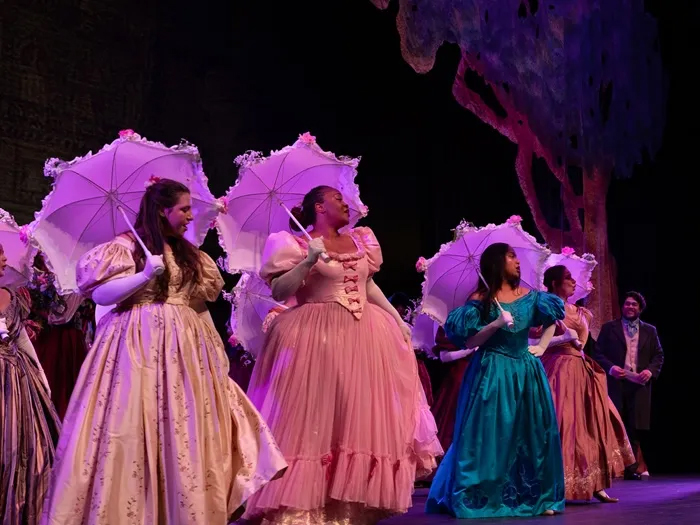
It premiered to a sold-out audience at Honolulu’s Blaisdell Concert Hall on May 1, with subsequent sold-out performances on May 3 and 5. This was a new frontier for HOT, whose previous seasons have featured warhorses (e.g., Rossini, Bizet, Wagner). But if you know you know: those familiar with Makuakāne’s 40 years of popular hula shows in San Francisco, with Honolulu tour engagements, knew that this production would explode with energy.
Vocal presence
And for opera fans, the title role casting of Hawaii-born Quinn Kelsey, the prominent world-class baritone whose operatic repertoire spans a broad range of roles performed at major houses worldwide including the Met, was quite the coup. For the San Francisco Opera, he has sung the title role of “Rigoletto” and will sing Scarpia in “Tosca” this season.
He didn’t disappoint with his enormous vocal and physical presence, his instrument rich, clear, and commanding in Hawaiian and English. Despite his star power, he didn’t set himself apart from the ensemble, he lifted it, and his tremendous acting chops conveyed Kamalehua’s humility and vulnerabilities with almost surgical precision.
Kelsey’s scenes with the also superb Brendan Boyle as Kamehameha III were reminiscent of the tenor-and-baritone “Au Fond du Temple Saint” duet from “The Pearl Fishers” (in which Kelsey, by the way, sang a widely-praised Zurga in English National Opera’s 2010 production).
The cast as a whole was luminous, with standout performances, besides Kelsey and Boyle, by John Pickle, a villainous Alexander Simpson, a British Consul attaché; Tasha Hokuaa Koontz as Kamalehua’s wife Hana; Joshua Jeremiah as Reverend William Richards (Rikeke); and Blythe Kelsey as Kekauluohi, the Queen consort.
Emotive qualities
The emotive quality of Herb Mahelona’s brilliant harmonic score, especially the ravishing Kamalehua and Monarch brotherhood motif, was keenly conducted by Lance Inouye leading the Hawaii Symphony Orchestra. And Victoria Nalani Kneubuhl’s libretto captures the roiling real-world tensions of the times ultimately eclipsed by Hawaii’s mystical and spiritual intensity.
The staging is simple but effective. The curtain stays up for the 150 minutes of fluid sequences on a set dominated by two sheltering trees depicted on either side, awash with changing light and color, and evocative backdrops.
The chorus in “Kamalehua” is exceptional, including a wry tone-setting troupe of five adroit male hula dancers (Makuakāne’s own dancers from San Francisco) who open the opera, move props, and act appropriately clownish, aggrieved, or indifferent with stylized expression and movement. They were Christopher Brodie, Ryan Fuimaono, Jason Laskey, Jason Ogoo, and Neil Romabiles. They were joined at times, radiantly, by the Honolulu-based kumu hula and Makuakane’s hula sister, Ka’ilihiwa Vaughn-Darval.
A few quibbles, both minor, in the second half: in one scene, in full lighting, two stagehands with headphones walk on to move a rock bench when it could’ve easily been handled by chorus members already onstage; and in the penultimate scene, during which Kelsey sings heartbreakingly, “May the water of Hawaii come raining over me…”, an angel (a gorgeously-costumed Sarah Hodges) lingers a tad too long.
This was Makuakāne’s first outing directing and choreographing an opera. Obviously, HOT trusted him for his musicality and integrity, and he delivered. A dynamic showman, he takes big swings with his projects, and has provided us with numerous thirst-trap moments over the years, but he’s also measured, bringing subtlety and nuanced touches to this aloha-loaded ode to his heritage.
At the end of the curtain call, everyone on stage – cast and creative team – chanted and danced hula in unison to the battle cry, “Hole Waimea,” a fierce and life-affirming coda.
Makuakane said in a recent local media appearance that he hopes to bring “Kamalehua” to San Francisco in 2029 if he can find backers and half-a-million dollars in funding. His steely determination is not to be underestimated. As HOT’s Board President told a group of us ticket holders during pre-performance lobby chatter, “Whatever Patrick touches turns to gold.” Wherever this exquisite opera lands, hopefully sooner than 2029 and in San Francisco, it is not to be missed.
https://www.hawaiiopera.org