The last time I interviewed Patrick Makuakane, Artistic Director of Na Lei Hulu I Ka Wekiu, his company had just received a Special Award from the Izzies Committee for The World According to Hula. When he introduced the company, the emcee made a cringe-worthy Hollywood hula gesture, you know the one—Lucille Ball does it in Dance Girl, Dance (1940), Debbie Reynolds does it in Singin’ in the Rain (1952), the Minions do it in Despicable Me 3 (2017). Makuakane graciously accepted the award and gracefully admonished the emcee for promoting the very stereotypes he has long sought to dispel.
photo by Ron Worobec
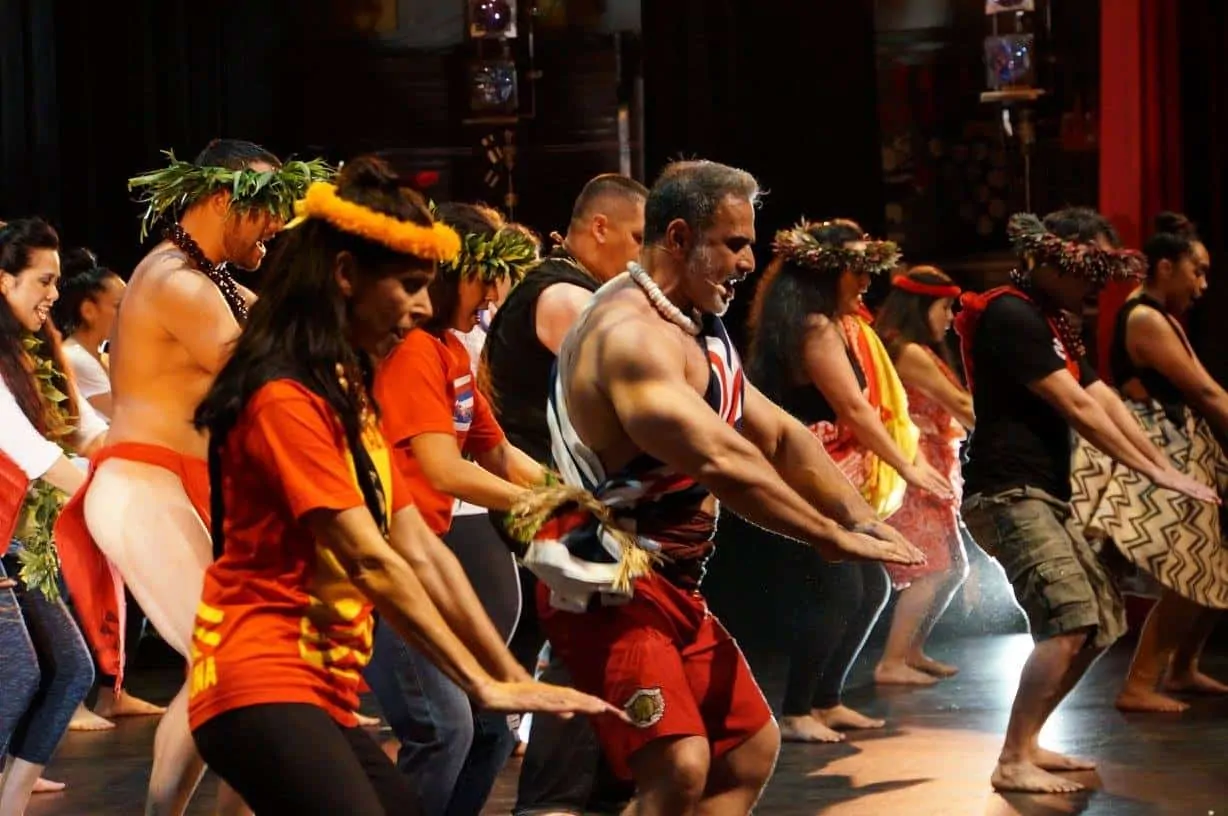
This was in 1999. Today, Makuakane is happy to report that hula is living its hashtag moment, at least in the Bay Area; folks have awakened to the cultural realities of hula as an art form, cultural practice, and way of life. This month, Makuakane and company present I Mua: Hula in Unusual Places at the Palace of Fine Arts. Right away the subtitle got me thinking about what constitutes an unusual place for hula, and the only thing that came to mind was “not Hawai’i.” I assumed that the moment hula hits the mainland it becomes unusual.
Makuakane explains that San Francisco both is and isn’t an unusual place for hula. Hawaiian music and dance were featured at the Panama Pacific International Exposition at the 1915 World’s Fair at the Palace of Fine Arts, where the company has its home season, and Hawai’i Pavilion headliner Lena Machado and her group were voted audience favorites at the 1939 and 1940 World’s Fairs on Treasure Island: “So there has been a longstanding appreciation for Hawaiian music and a relationship between California and Hawai’i, in part because of the proximity. Hawaiians move here more readily than anywhere else, making it easier for us to do our cultural work here.” Still, Makuakane concedes, “considering its traditional origins, this is a strange place to be doing hula. I guess because I’ve been doing it for thirty-something years over here it doesn’t feel strange anymore.”
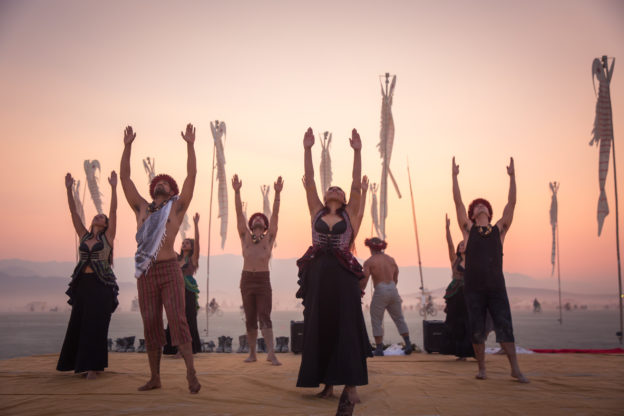
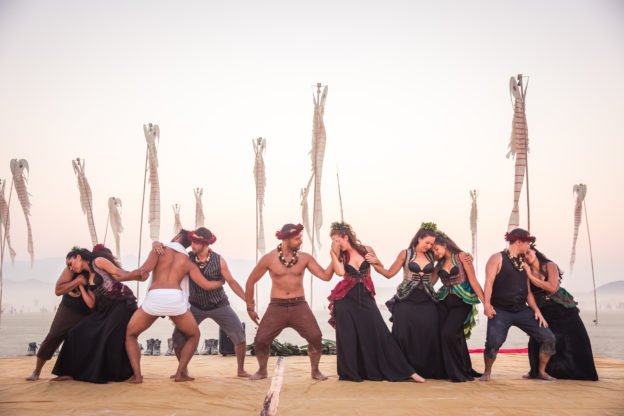
What did feel strange was when Makuakane brought 10 members of his company to Burning Man for the first time three years ago. Indeed, images of the company dancing in a haze of gray playa dust contrasts sharply with visions of blue waves and lush green. But the burners embraced the hula dancers: “I can’t tell you how blown away I was by the inventiveness, the subversiveness, the acceptance, the radical expression of self, and the loving embracing community—it reminded me of our community, very welcoming.” The ubiquity of electronic music at Burning Man also inspired Makuakane: “I’ve been fusing electronic music with my dance for a while now. I put everything I had in my arsenal—electronic music, traditional chants—and people loved it.” When we spoke this past August, Makuakane was about to bring his whole company to Burning Man, an unusual place turned desert home for hula.
I Mua: Hula in Unusual Places is a proscenium performance that draws its spirit from Makuakane’s Hit & Run Hula, a series of hula flash mobs that have taken place all over San Francisco, in New York City (Times Square, Brooklyn Bridge), and, one time, on a Hawaiian Airlines flight from San Francisco to Hawai’i. Makuak?ne loves the way these performances work the element of surprise in two directions—audiences don’t see it coming and the dancers don’t know how they’re going to be received: “When Hawaiian Air hired twenty of us to dance on the plane to inaugurate a new flight out of San Francisco, they played one of oursignature pieces, I Left My Heart in San Francisco. One by one the women got up to dance in the aisles from first class all the way down to the back. I remember looking back and seeing this one gentleman very annoyed because he was trying to open the overhead bin to get his bag and there was this hula dancer in front of him. He was waiting for her to go back so he could jump up and remove his bag. For me that just made it. That was perfect. Not everyone was like, Oh, wasn’t that pretty. This guy was like, You’re in my way, I need to get my bag. Life is happening as it moves.”
Makuakane never gets permits to perform Hit & Run Hula and he has learned how long it takes on average for law enforcement to show up: “These pieces are a minute to a minute and a half long. Several times we’ve just finished a piece and some security person will come up and say, Hey, you can’t do that here although it’s really nice. And I just turn around and say, I’m really sorry, thank you, we’ll be on our way. But my piece is finished already!”
Makuakane calls his style of hula, hula mua, which he defines as “the kind of hula that moves forward.” The upcoming performance is titled I Mua, a common term in Hawai’i that means “move ahead,” among several related meanings like
“straight ahead” and “let’s do it!” Makuakane says he titled the show “in a very Hawaiian way. That is, you never really refer to something directly but obliquely. Especially in mele or Hawaiian music, or poetry, the mele that accompanies the dance often speaks in metaphors and hidden messages. The power of deduction is what’s interesting.” I wondered aloud whether modernist dance forms have suffered from the autonomizing gesture that dislocated movement from other forms of expression, severing the ties to verbal speech in ways that prevents audiences from using that power of deduction to make sense of and thereby more deeply enjoy the work. “I definitely engage in that conundrum myself,” Makuakane said, “because hula is a dance form that we dance to Hawaiian language and 99.99% of my audience doesn’t know what the dances are about. So in my shows I incorporate narration in a way that gives the audience a little hint but doesn’t overwhelm them.”
photo by Ron Worobec
Makuakane’s concept of an unusual place encompasses the geographic, the auditory, and the corporeal. Hula mua challenges essentialist theories that certain dances belong on certain bodies to certain music in certain places.
One of Makuakane’s most cherished sites for teaching hula is San Quentin State Prison: “I teach in the chapel area. It’s not a hula class, it’s a Hawaiian spiritual group meeting, a service, under the auspices of the Religious Freedom Act. I went to (Catholic) church throughout grade school and high school, and never felt any connection. Then I started hula and realized this thing I’m feeling, this connection out of self to the world, I think this is what I’m supposed to be feeling at church. In some ways I can see that in the guys when they’re in class. There’s this connection with community, arms and hands moving in space accompanied by some kind of chant or music. It’s a time when I see their walls come own, and they’re vulnerable and open, and always very respectful. It just goes to show not only the power of dance—I hate that phrase, it’s more than that. It’s community, it’s acceptance, it’s acknowledgement, all of that plays into a successful community and then you add dance to it and, wow, how could you not be inspired and interested in that.”
When Makuakane was growing up on Oahu in the 1960s, native Hawaiian culture was very much on the periphery of his family and community events. But in the 1970s, a Hawaiian cultural renaissance invited people to ask questions about their identity as native Hawaiians. According to Makuakane, many moved into the fields of music and dance to find answers to those questions: “I found all those answers in hula. Dance is what saved our culture and language in the 70s. Now we’re in the midst of another renaissance of knowledge, people going back to study traditional applications and methods, dancing, canoeing, farming, wayfaring, sending their kids to Hawaiian language immersion schools. I’m amazed.” And since all identities are intersectional identities, hula offered Makuakane a way to embrace his ethnicity, spirituality, and sexuality: “In high school, when I told my mother and sister that I was going to be a hula teacher, they were like, ‘Oh, so you are gay!’” They didn’t really say that. But when Makuakane brought that conversation up 25 years later after earning the right to be a kumu hula, he asked his sister and mother, “Do you remember that conversation? Yes. And did you think that? Yes.” Makuakane had a good laugh over that one.
Stereotypical assumptions aside, Makuakane did find hula to be a place where he felt safe being himself: “My main teacher was gay, not out or anything, but a flamboyant guy being himself; he didn’t look like he was hiding anything. And he was the leader of all these young guys who were football players, big macho guys, learning to dance by moving their hips. And I was like, Where’s that magic wand at?” As hula began having its renaissance in the 1970s, more and more boys and men were drawn to the form as a way to express their native identity: “It was becoming more acceptable. You were still called a fag, and some groups were deemed more faggy than others. My group was one of the faggier groups.” This sparked a movement to develop a hypermasculine style of dance, “almost as if a way to let people know [grunts], we’re not gay.” Though this style may be traced to lua, Hawaiian martial arts, which “traditionally speaking, have a close relationship with hula, in the oldest archival footage of people dancing hula it’s very soft and flowing.”
Makuakane hadn’t planned to stay in San Francisco when he moved here to be with his partner in 1983. After three months, he’d found home. “I couldn’t do a show in Hawai’i called Hula in Unusual Places. Here I can. I am going to take the show back to Hawai’i next year, but it was important for me to plant the seeds in San Francisco. The gay scene, the modern dance scene, this unique experiment with life.” Makuakane’s whole career has emphasized the fact that dances are connectedto places and people, and, at the same time, are roomy enough to include and engage other places, other people: “Here I am doing hula outside of the mothership, and I feel like I’m set free.”
For two weekends in October 2016, famed dance master Patrick Makuakāne took his audience on a stirring visit to Hawai’ian culture through dance, chant, song and video.
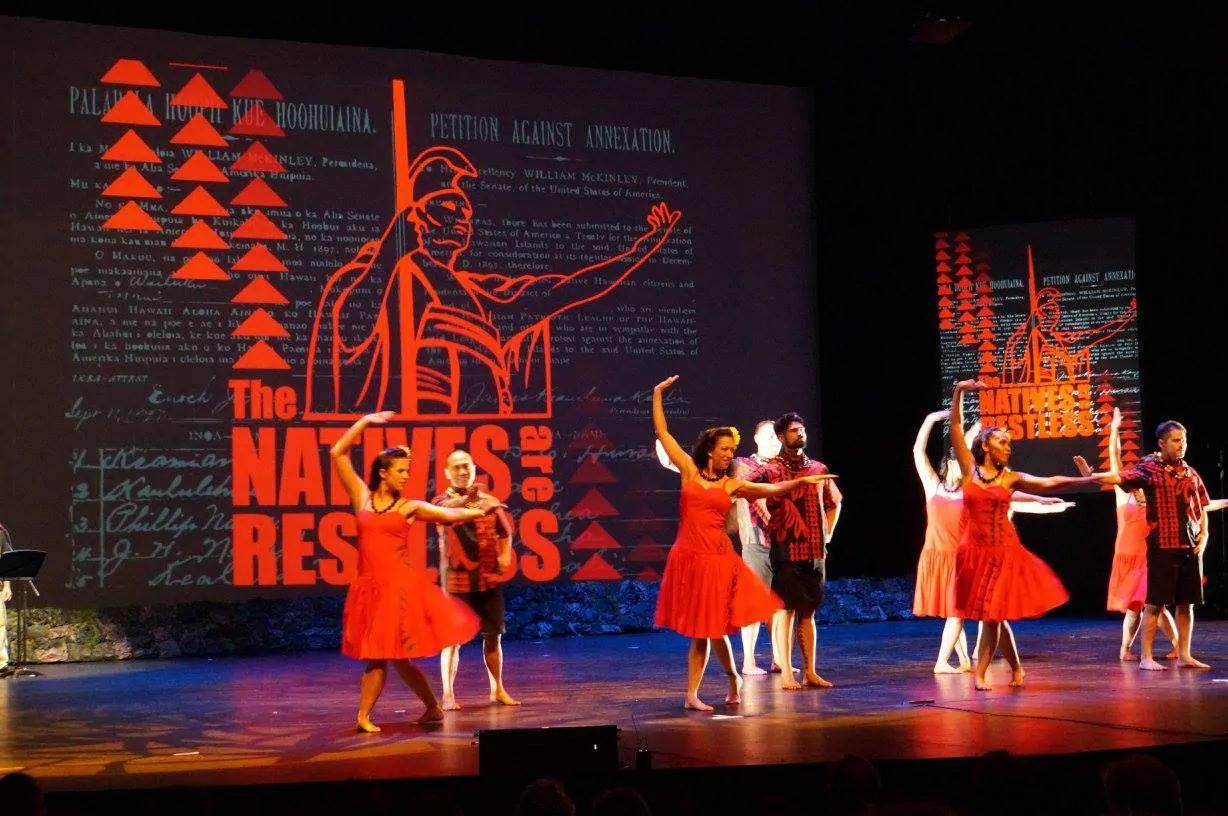
His recent stage production, entitled The Natives Are Restless, showcases the latest developments in hula dance and Hawai’ian political activism. It also highlights publication of a new coffee-table book which tells the story of Makuakāne and Nā Lei Hulu I Ka Wēkiu , one of the largest hula schools in the world.
Crucial to a society with a strong oral tradition was utilization of song and dance to celebrate the gods and tell stories.
Hawai’ian native and Oakland author Constance Hale wrote the coffee-table book. She was quoted in the SF Chronicle as saying, “hula is not just lyrical and pretty. It is ancient, powerful. It can be very political. It can be fierce and in your face.” She has studied with Makuakāne for 20 years.
The stage performance and the book explore hula mua, a dance style invented by choreographer Patrick Kakuakane, which retains some of the sacred and sensual traditions of Hawai’ian culture but also includes contemporary influences from Hollywood and Broadway to hip hop.
For many Americans this stage production will be a shock and wake-up call about the troubled history of our 50th state, which was an independent monarchy before a group of American businessmen violated a U.S. treaty by overthrowing queen Liliuokalani. She was the first and only reigning Hawai’ian queen, and the last sovereign to govern the islands before the U.S. annexed that country in 1898.
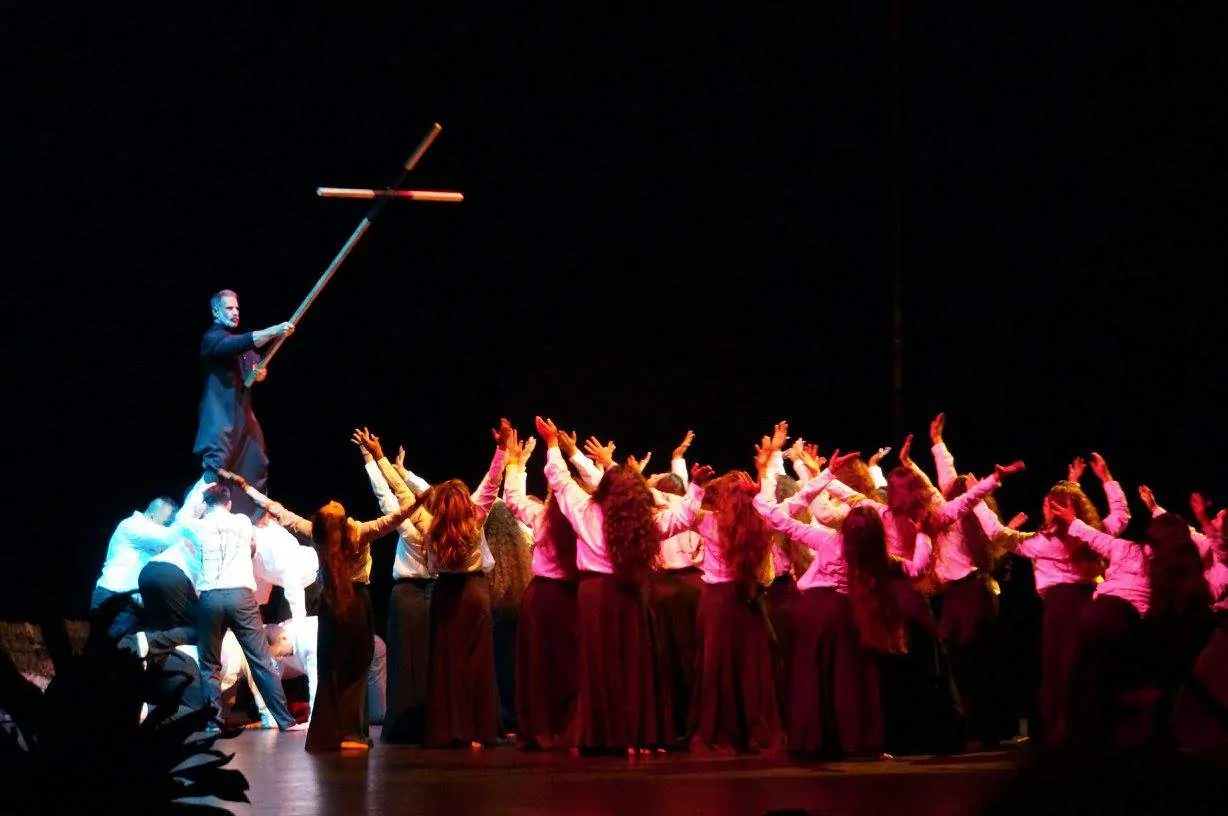
Utilizing his profound knowledge of Hawai’ian history as a sovereign nation and as an exploited colony of the U.S., Makuakāne traces the culture from its ancient origins to the changes brought by Christian missionaries and capitalists right into the modern period of strong political activism and lawsuits. We see rare film footage and photographs of those who fought to preserve Hawai’ian independence in the 19th century and early 20th century.
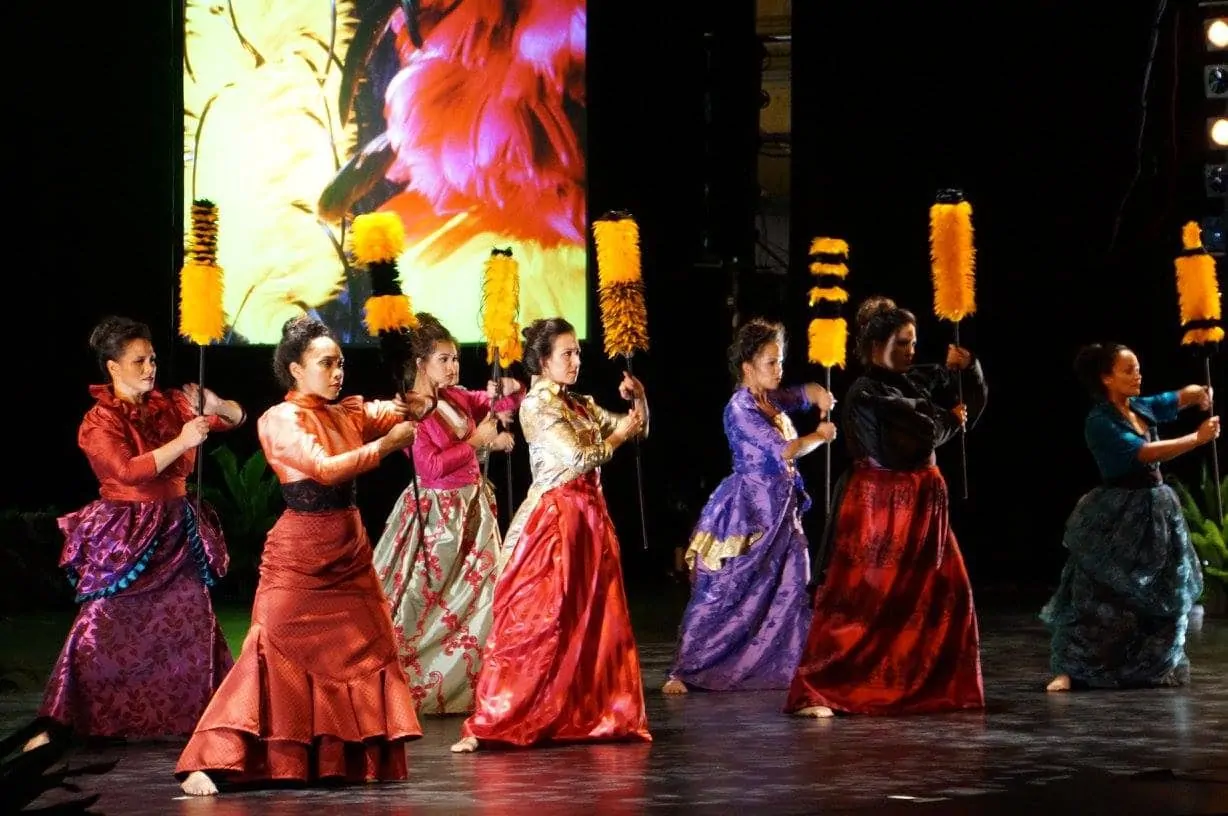
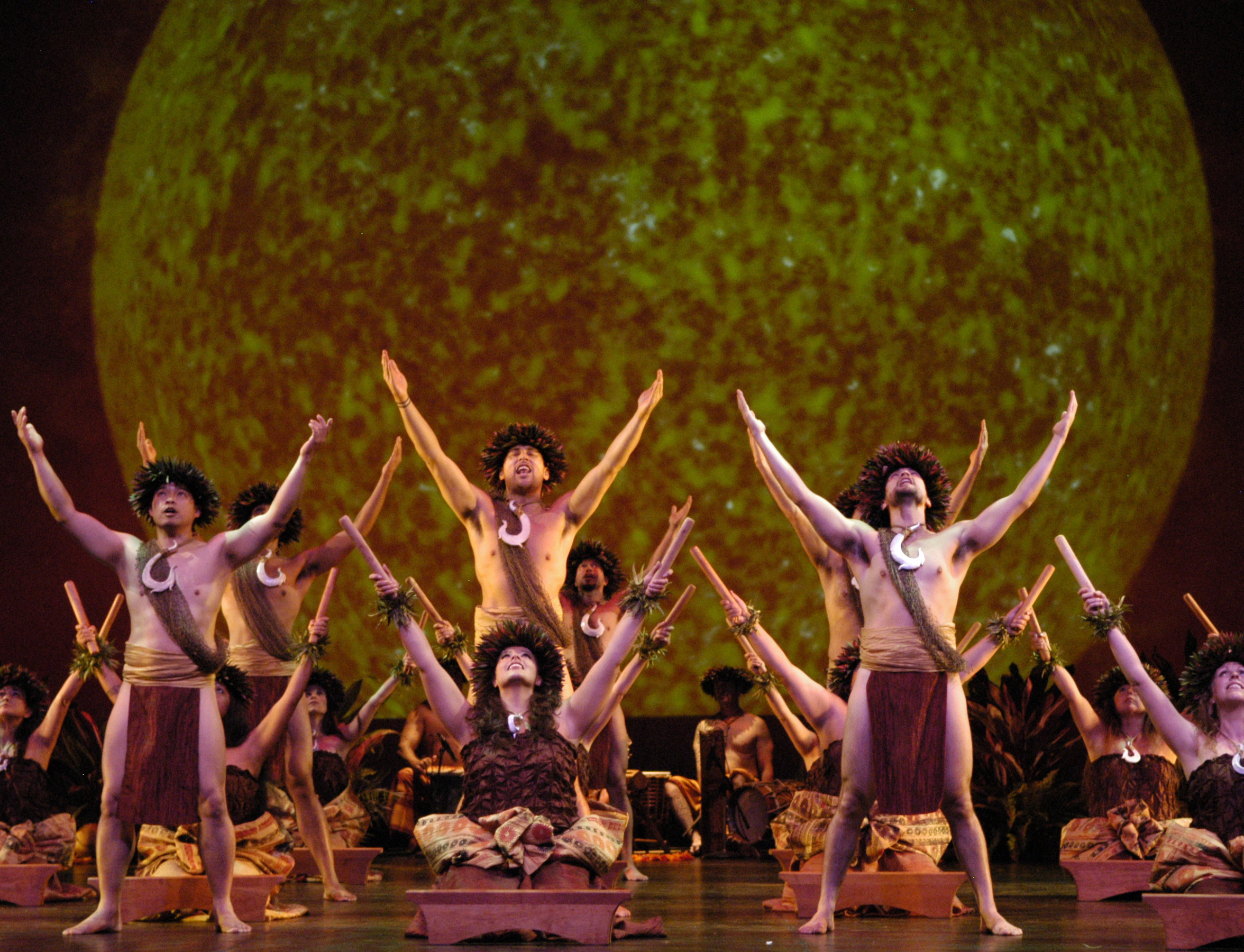
The costume changes alone are fascinating. Original Hawai’ians covered themselves more in tattoos than garments due to the intensely humid climate. Both male and female dancers eventually wore a short skirt around the waist, made of bark or banana leaves. A floral wreath or lei covered their heads and a combination of greens and shells decorated their ankles and wrists. Feathers were used to designate social position, including capes woven of feathers. Both genders wore a rectangular shawl or Kihei for protection from rain. Such costumes were light enough to be comfortable and did not harm the environment.
The costume changes alone are fascinating.
Crucial to a society with a strong oral tradition was utilization of song and dance to celebrate the gods and tell stories. This vigorous form of dance was denounced by Christian missionaries and Hawai’ian royalty was forced to ban it. These important dances continued in secret to preserve the culture, but costumes were altered. Women began to wear long skirts or muumuus, and men started wearing trousers and a wrapped loincloth or malo. Throughout the music-filled evening, Makuakāne incorporates rich fabric in striking designs based on the clothing of various social classes. All ages and colors appear as singers and dancers in this vibrant production.
IN PHOTOS: Nā Lei Hulu I Ka Wēkiu – The Natives are Restless
And the music! As a former DJ, Patrick is able to incorporate multiple instruments and rhythms to recreate traditional chants and to enliven contemporary political issues with more modern musical approaches, all the while remembering the purpose of his theatrical production – to bring the struggle for Hawai’ian independence sharply into focus while allowing the audience to enjoy itself.
WATCH: Nā Lei Hulu I Ka Wēkiu BTS & Interview with Patrick Makuakāne
Excellent production values in The Natives Are Restless, from music and dance to costumes and backdrops of oversize photos of a lost civilization being reclaimed. Terrific turnout at the Palace of Fine Arts with nearly every seat filled. And Constance Hale’s book sold briskly.
Among local celebrities present was Leilani Birely, Hawai’ian priestess and ceremonialist who brings ancient Hawai’ian healing and wisdom to her community. She also studied with Patrick Makuakāne.
If you missed The Natives Are Restless this year, be sure to look for it next autumn, and prepare to be transported.
An unprecedented, interdisciplinary manifestation presented in partnership with the Yerba Buena Gardens Festival, The Ola Project combines chants, music, dance, lectures and sculpture as a celebration of the Bay Area legacy of Patrick Makuakane’s hula school and dance company Nā Lei Hulu I Ka Wēkiu. Ola means life in Hawaiian, and the event centers around the erection of a kuahu – a traditional Hawaiian shrine that serves as the focal point of the day’s activities. With hundreds of performers descending upon the gardens to dance, sing, build and celebrate, The Ola Project is a welcoming Hawaiian experience resonating with tradition and connectedness.
Hawaiian culture runs deep in the Bay Area, and one reason is the work of Patrick Makuakāne, the founder and leader of the dance company Na Lei Hulu I Ka Wekiu. The company celebrates 30 years of hula mua (“hula that evolves”), based on Makuakāne’s innovative choreography and musical choices, with a series of concerts at the Palace of Fine Arts in San Francisco running from Oct. 17–25.
We recently sent Makuakāne some questions about Na Lei Hulu’s history, and his work, with its mix of power and grace. Here’s the interview.
Your dances are rooted in tradition, but borrow from modern styles. And you sometimes use pop music, like Lady Gaga’s “Born This Way.” What do you gain by shaking things up like that?
I feel that hula is one of the most beautiful forms of expression in dance and I don’t want to limit it just to Hawaiian music. Traditionally speaking, the poetry associated with the dance is the main vehicle that expresses the story. As much as I love Hawaiian music and chants, I’m also inspired and intrigued by other genres and feel that hula is a perfect way to embellish those beautifully crafted stories, whether it’s from Lady Gaga, Tony Bennett, Roberta Flack, or Kuana Torres Kahele.
Why is it easier to innovate here on the mainland than in Hawai’i?
A friend from Hawai’i once mentioned to me that it must be great practicing hula without anyone peering over your shoulder judging your work. I never thought about it that way, but he had a point. There’s definitely been a sense of liberation (as well as isolation) without having to deal with a running commentary about the work. Basically, I felt free to do whatever I wanted. And did.
You call your hula style hula mua. What does that mean?
Mua is a word that can mean forward/ahead or even before, depending on how it’s used. I like to think of Hula Mua as bringing something from the past and advancing it to the future.
Na Lei Hulu dancers (Lin Carliffe)
The Bay Area’s a hotbed of traditional ballet, modern and ethnic dance styles. What kind of dance has had the most influence on you?
I have seen a plethora of dance styles living here in the Bay Area which I deeply admire, but the style that speaks to me the most is hip-hop. I love the intricate use of hand/arm movements and the dynamic way it’s linked to the lower body. It reminds me of a highly stylized hula.
You studied with some of the great hula masters, and yourself are now a master, a “kumu hula.” What do your old teachers say about your style, and do you worry about offending them?
Interestingly enough, one of my teachers is a staunch traditional exponent and yet she loves our modern interpretation of hula. She appreciates the fact that I am committed to passing on everything she taught me as it was taught. I strongly feel that these beautiful traditional heirlooms are perfect in their pristine state and I don’t feel the need to re-imagine them in a contemporary format.
Conversely there are no rules in hula that say I cannot choreograph or create dances accompanied by pop, electronic or alternative music. I’m not here to turn tradition on its head. I believe that preserving your traditions while simultaneously evolving your art form are not mutually exclusive pursuits and my teacher agrees. As long as she’s happy, I’m happy!
You’ve been teaching hula and leading your hula company Na Lei Hulu I Ka Wekiu for thirty years. How has your teaching changed over the decades?
I’ve learned to trust my instincts more and more. Sometimes I’ll leap then look. As I’ve gotten older, I’m able to be really be present when I’m teaching, feeling the power and beauty of the moment in a way that I wasn’t able as a young “kumu” (teacher). I’m also more grateful than ever to have such a meaningful way to connect with others through hula, be it my students, colleagues or the audience.
What have your students taught you in that time?
There is a saying in Hawaiian, “Aohe hana nui ke alu ia,” meaning no task is too great when done together by all. We have accomplished tremendous work throughout the years and that’s because everyone in the community works together to ensure that we can make anything happen.
What have you got planned for the next thirty years of teaching?
I’m not sure about the next thirty years… It’s been a glorious ride so far and I’ve taken things as they come, one fantastic experience after the next. But next year, I want to take my company to Burning Man! Hula in the desert. We thrive in environments that seem counterintuitive for hula and I’m already imagining a lyrical, traditional piece accompanied by electronic music, danced in a dust storm.
For those of us who grew up on the East Coast, what little we knew about hula came from the movies. Shortly after moving to San Francisco on my 25th birthday, traditional (as opposed to commercial) hula became more visible to me.
In 1977, during a week-long vacation in Seattle to attend a production of Richard Wagner’s Der Ring des Nibelungen sung in English, I took a day-long tour to the famous Butchart Gardens in Victoria, British Columbia. As our sightseeing boat headed across Puget Sound, I was surprised to see a small group of elderly Asian women practicing hula on the front deck to help pass the time.
I still cherish the memory of how, back in 1984, Raymoki Julamanu Engler (who used to perform under the stage name Hulamanu o Hawaiki) electrified an audience with his performances of “The Genital Hula” and “Great Balls of Fire.” Later, when I interviewed Raymoki, he explained that:
There was no written language in the Hawaiian culture. History and legends were passed from one family to another through chants. Some of the chants were very poetic. The common people couldn’t understand them, which is why dancing was used to illustrate what was being said. The chant was important, not the dancing. Today it’s reversed.
Ten years ago, when a group from Los Angeles participated in the Merry Monarch Hula Competition in Hilo, they performed their ideaof Hawaiian dancing. These Hollywood people came out in feather capes chanting all kinds of stuff without even knowing the language! The native Hawaiians (who were performing ancient and modern hulas) were laughing so hard that there were tears streaming down their cheeks!
Hula dancing is a lot like sign language: If you don’t know the language, you can’t enjoy it as much. When the Islanders heard that a group from San Francisco was competing, they thought they could have themselves another good laugh. They thought we would all have blond hair and blue eyes. But we looked like locals, instead. Not only did our Hawaiian cowboy hula place third in the modern hula division, we also put San Francisco on the Hawaiian map by showing them that we knew what we were doing.”
In 1990, while in Honolulu, I caught a production by Hawaii Opera Theatre in which Mozart’s Cosi Fan Tutte had been updated to the Hawaiian monarchy period and renamed Pela No Ho’i Na Wahine.
The production’s scrim had been inspired by Madge Tennent’s drawings of Hawaiian women.
Ferrando and Guglielmo became two American naval officers stationed in Hawaii at the turn of the century while Don Alfonso was renamed Don Amalu and portrayed as an elderly local Hawaiian happy to take their money.
Fiordiligi was renamed Pualani, Dorabella became Keanani, and Despina was transformed into a girl from Maui named Leilani, who clearly understood that “to catch mynah bird, you use guava.”
“Addio” was translated into “Aloha,” “Ziti, Ziti” became “Wiki Wiki” and, at one point, Don Amalu told someone to “Shoto make!” (Shut up!).
The action took place on the lanai and in the gardens of a Waikiki hotel (with Diamond Head visible on a backdrop). Drinks were served on the hotel’s patio by a huge Samoan man dressed in a sarong and, before the men sailed off to war in an outrigger canoe, the girls dutifully draped floral leis around their necks.
A chorus of three lei sellers in traditional Hawaiian costumes sat on the side of the stage interpreting the trio sung by Don Amalu, Pualani, and Keanani with hula gestures.
Before you could say King Kamehameha, the men returned disguised as two rakes from the Russian colony on Lahaina.
When the two sisters tried to remain faithful to their boyfriends, Leilani chided them by asking “Are you two wahine? Or are you…coconuts?”
In Act II, when Despina is required to disguise herself as a physician, Leilani entered dressed as a Hawaiian kahuna carrying a lump of glowing lava. For the wedding scene, she reappeared in the guise of a Chinese lawyer from Yick Lum Plum (a corporation that made a popular snack food in Hawaii).
By evoking visual images and using a vocabulary dear to the hearts of native Hawaiians, Terence Knapp’s production imbued Mozart’s opera with such a strong sense of Hawaiiana that the production became a truly indigenous operatic experience. While in Honolulu, I interviewed
John Kaimikaua, a local Kumu Hula who gave me a crash course in hula’s role in keeping Hawaii’s oral tradition alive. Since then, I have attended several Bay area hula events at which the smell of fresh flower leis was simply intoxicating.
Because so many Hawaiians have settled in the San Francisco Bay Area, hula concerts showcasing local halaus take place throughout the year. Sponsored by the Kumu Hula Association of Northern California, Ia ‘Oe E Ka La 2010 will take place at the Alameda County Fairgrounds from November 5-7.
In celebration of 25 years of hula under its founder and Kumu Hula, Patrick Makuakane, San Francisco’s most famous halau, Na Lei Hulu I Ka Wekiu,debuted its latest show at the Palace of Fine Arts on October 16. Na Lei Hulu I Ka Wekiu’s performances are wondrously rich in costume, song, and Hawaiian history.
Ever since arriving in the Bay area as a student, Makuakane has been teaching and promoting hula. On a recent tour of Japan with several Hawaiian hula troupes, he was amazed to discover that more than 250,000 people are studying hula in Japan!
As Makuakane’s hula concerts have grown more technically sophisticated — and Na Lei Hulu I Ka Wekiu’s audiences have grown in size — it’s been easy for people to overlook Patrick’s strength as a showman and choreographer with a keen artistic vision. Part of Makuakane’s strength has been to choreograph traditional (kahiko) and contemporary (‘auana) hula pieces.
However, with a company of 40 dancers, Makuakane’s trademark has been his success with hula mua (hula that evolves). He has created numerous nontraditional hulas that use music ranging from Delibes to techno, from popular songs like “I Left My Heart in San Francisco” to “The First Time Ever I Saw Your Face.” He has won numerous awards for his choreography and direction, including several Isadora Duncan Dance Awards (“Izzies”) and a lifetime achievement award from the San Francisco Ethnic Dance Festival.
Na Lei Hulu I Ka Wekiu’s 25 Years of Hula show opened with a section devoted to the impact of the missionaries on native Hawaiians. The powerful last two numbers in this part of the program (“Walk With Me” and “Save Me”) would fit beautifully into the repertoire of any modern dance company.
In addition to using hula concerts for educational outreach purposes (Makuakane talked about King David Kalakaua’s love for the arts and his death at San Francisco’s Palace Hotel on January 20, 1891), Patrick was joined by his “hula sister” Kumu Hula Shawna Kealameleku’uleialoha Alapa’i, his “hula brother” Kamaka Kukona, local drag performer Matthew Martin, drummers Kris Lee and Derek Sam, and newly-married musicians Lihau Hannahs Paik and Kellen Paik. In his program note, Makuakane wrote that:
“To commemorate our silver anniversary, we are excited to present the full-length premiere of Ke Kumulipo — He ho’ohanohano (The Kumulipo — An Homage). The Kumulipo is an epic Hawaiian creation chant that majestically recounts the evolution of the world we live in. Our homage to the Kumulipo depicts the birthing of sea plants and animals, the creation of mountainous islands, the rich flora and fauna that cover the land, and the emergence of the first men and women and their subsequent generations. We collaborated once again with Hawaiian scholar Lucia Tarallo Jensen, who provided an insightful and profound translation of this ancient poem, reclaiming nature’s song of origin. The Kumulipo expresses harmony with our environment and ultimately highlights our connectedness with the natural world, with each other, and with everything around us. We believe this ambitious project marks the first time that this tale has been brought to life through hula.”
Makuakane’s hula shows have always paid respect to the Hawaiian culture’s love of nature. With this year’s push toward an increased use of multimedia, the audience was treated to some spectacular video effects by Wally Murray while performers were showcased by Patty-Ann Farrell’s sensuous lighting designs. As always, Makuakane’s chanting and narration were a highlight of the evening.
A collection of videos on YouTube show a series of “Hit and Run Hula” performances by Na Lei Hulu I Ka Wekiu, including the following performance on the slopes of San Francisco’s Dolores Park.
One of the trademarks of Na Lei Hulu I Ka Wekiu’s performances is that the audience always seems to leave the theatre glowing with warmth and satisfaction. A great deal of credit for this goes to the halau’s top-notch production team which, year after year, aims higher and higher — as well as to Patrick Makuakane’s unique artistic vision.