Patrick Makuakane, the San Francisco kumu hula who was recently awarded a MacArthur Genius grant, describes himself as a “cultural preservationist.“
What he means by preservationist is very different from what people in Hawaii usually mean by that.
They talk about maintaining. Makuakane talks about innovation.
Preserving the culture, Makuakane says, is all about innovation. “Our ancestors were highly innovative people. What I’m doing,” he says, talking about his dances, “is keeping that innovative spirit of our ancestors.”
That’s not the common way people here think about culture and change. It should be.
We talk about aloha and ohana as if those are permanent values that never change and never should, as if Hawaii is still a pristine, isolated place in the middle of the ocean that needs to protect itself against those alien winds of change that come from somewhere else.
High walls to maintain the differences between Them and Us. Fragility and threat.
That’s Hawaii’s version of what the historian William Cronon, in his amazing environmental history of Chicago, “Nature’s Metropolis,” calls the pastoral myth.
That myth had been a part of American life since the country’s beginning and still lingers today.
The pastoral myth makes a clear distinction between urban and rural. Rural is good, urban is bad.
The countryside is the family farm — yeoman farmers, mom, pop, and the kinds living and working together self-sufficiently. Pristine, pure and isolated from the city. Splendid isolation. Keeping distance and keeping the faith
Urban life, on the other hand is noisy, crowded, corrupt and polluted morally, as well as industrially. The city is to be feared and to be avoided.
In Hawaii’s version of the pastoral myth, Hawaii is the pastoral, filled with unusually moral people living right while the outside world, particularly the mainland, is the equivalent of the wrong-living, morally questionable city.
The outside? Go there, but beware, and don’t stay long because if you stay, you will lose yourself and what you stand for by becoming one of “them.” Your home is here forever.
Cronon shows how the urban-rural barriers disappeared as railroads blanketed the country, farms changed, farm kids sought better opportunities in the cities, and people from rural areas began to find the city an attractive if still frightening place.
The Council for Native Hawaiian Advancement held its annual conference in Las Vegas earlier this year. (Naka Nathaniel/Civil Beat/2023)
Twenty winners were announced to receive the prestigious MacArthur Foundation fellowship last week, including scientists, legal scholars, engineers, and a hula dancer.
Aiming to blend classical Hula dance with modern and contemporary elements, the artist says he is working to both preserve his culture as well as transform it into something new.
For more on this, KCBS Radio’s Pat Thurston spoke with the grant recipient Patrick Makuakane, Kumu Hula – master teacher – and director of a hula school and dance company in San Francisco.
Surprise, shock, honor. Such were the emotions of many of the MacArthur Fellows selected this year by the John D. and Catherine T. MacArthur Foundation.
“I was in total shock when I first learned about it,” said Dr. Linsey C. Marr, the Charles P. Lunsford Professor and University Distinguished Professor at Virginia Tech and one of the 20 individuals chosen to be part of the MacArthur Fellow Class of 2023. “It’s kind of a mixture of elation and excitement and good fortune, because there’s so many people out there doing great research.”
As part of the honor, the 20 fellows – selected and recognized for their groundbreak work and potential – will each receive an $800,000 ‘genius grant,’ issued quarterly over five years.
“The 2023 MacArthur Fellows are applying individual creativity with global perspective, centering connections across generations and communities,” said Marlies Carruth, director of the MacArthur Fellows program. “They forge stunning forms of artistic expression from ancestral and regional traditions, heighten our attention to the natural world, improve how we process massive flows of information for the common good, and deepen understanding of systems shaping our environment.”
Among the fellows this year were lauded scholars, poets, musicians, scientists, mathematicians, and writers.
Marr, for one, is a civil and environmental engineer with a specific focus on air quality, airborne pathogens, atmospheric science, and public health. Her research has involved studying today’s airborne issues such as air pollution and COVID-19 transmission.
It is understandable that many of the fellows found themselves caught off-guard by the award. The program – “intended to encourage people of outstanding talent to pursue their own creative, intellectual, and professional inclinations” – are awarded based on external nominators from various fields. The nominations are then evaluated while the nominees themselves are never officially informed of their nomination status unless selected.
The program has picked 1131 people as MacArthur Fellows since 1981, with roughly 20 to 30 selected per year.
“It’s shocking and astonishing. To be in the company of such esteemed fellows – molecular biologists, a poet laureate, legal and environmental scholars – that’s a huge deal,” said fellow Patrick Makuakāne, a choreographer and cultural preservationist who is the founder, director, and kumu hula (hula master) of Nā Lei Hulu I Ka Wēkiu dance company.
“And then there’s hula. [It] says to me that … maybe MacArthur understands how transformative it is to people’s lives, having hula in their life.”
San Francisco’s Patrick Makuakāne is among the 2023 class of MacArthur Foundation awardees, announced last week. Makuakāne, 62, is a famous master teacher of hula. In 1985, he founded a hula school and company called Nā Lei Hulu I Ka Wēkiu, whose name translates to “the many-feathered wreaths at the summit, held in high esteem.”
The MacArthur citation for Makuakāne calls him a “cultural preservationist” and credits him for “blending traditional hula with contemporary music and movements and uplifting Hawaiian culture and history.”
Talking to Slate after the award announcement, Makuakāne described his work in a different way, which writer Dan Kois summarized as “an artist working not to preserve his culture in amber, but to innovate and transform it into something new.”
SF Classical Voice has long followed Makuakāne’s work, noting how he is blending traditional and commercial hula with contemporary music, opera, electronica, alternative, and pop, along with other forms of dance. He has called this hula mua, or “hula that evolves.”
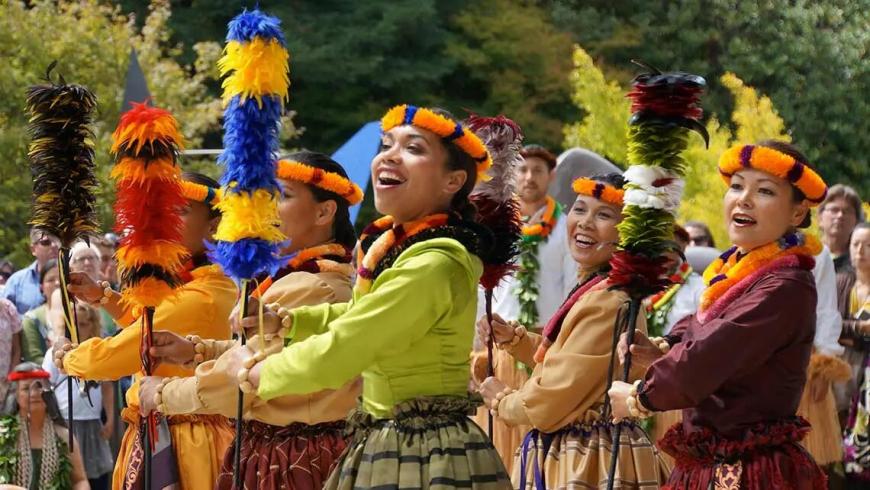
Makuakāne’s hula company in action | Courtesy of Nā Lei Hulu I Ka Wēkiu
In 2010, SFCV reported on Makuakāne’s company celebrating its 25th anniversary:
Creation myths are all around. Genesis, of course; the Kalevala for the Finns; Theogony for the Greeks; Dreamtime for the Australian indigenous people; and so forth.
In Hawaii, it’s He Kumulipo, a 2,000-line chant about creation and the source of darkness.
On Friday [May 21, 2010], San Francisco’s Asian Pacific Islander Cultural Center was the setting for the performance of an excerpt from a Kumulipo work in progress. Patrick Makuakāne’s hula school is developing a full-length work for presentation in the Palace of Fine Arts Theatre.”
In Slate last week, Makuakāne spoke of his relationship with hula and once again returned to the theme of origins, with Kois observing that “for many mainlanders, hula is just something they encounter in tiki bars or on TV.”
Makuakāne responded: “They have no idea what it truly represents! I’m an evangelist about hula. Hula is such an important, immersive, expansive part of our culture. It helped to bring the culture back from extinction in the ’70s, during the Hawaiian Renaissance.
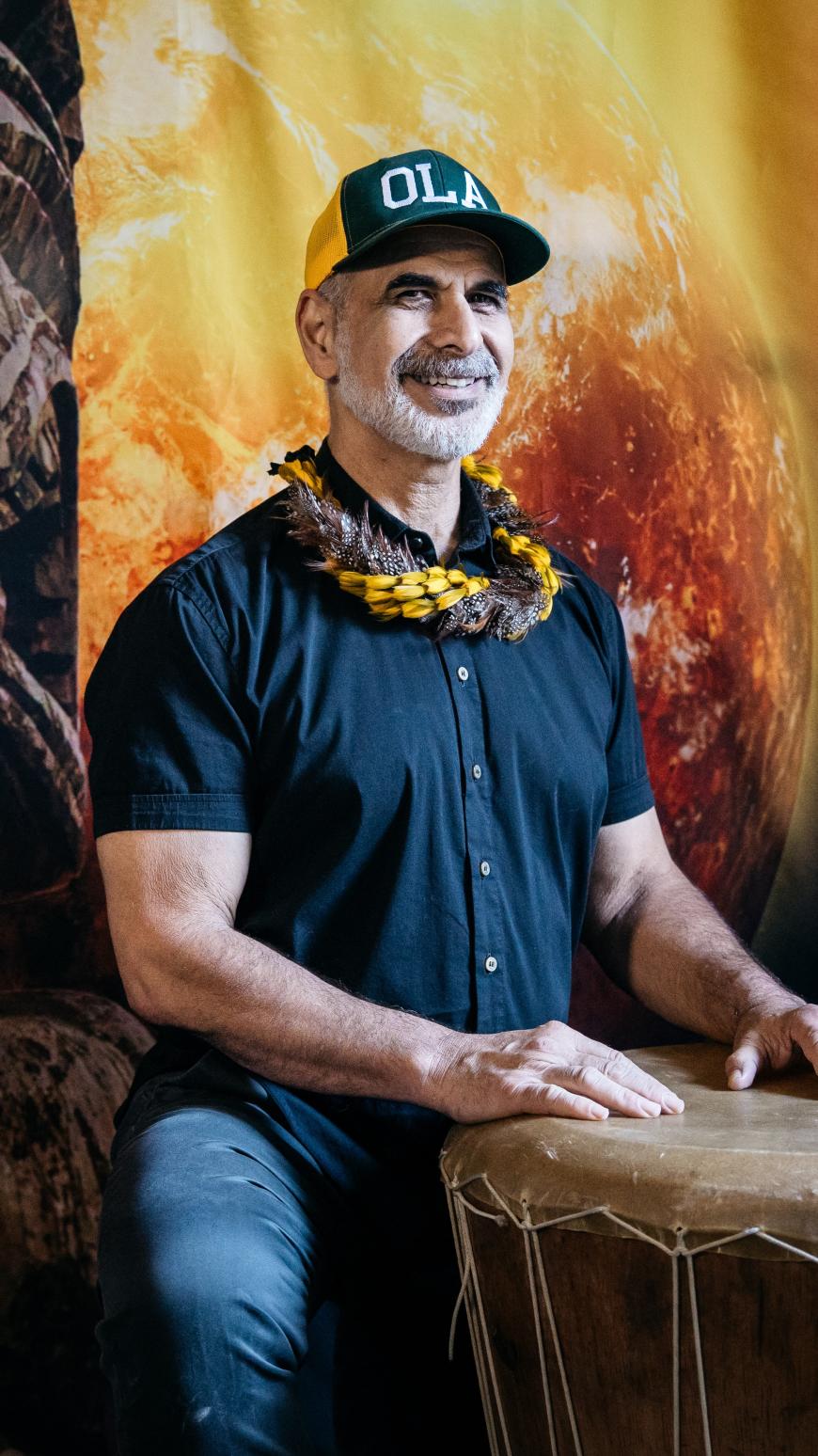
Patrick Makuakāne | Credit: John D. and Catherine T. MacArthur Foundation
“Everybody says it was music and wayfaring, and I say boldly that it was hula that did it. I’m biased, but you can be biased and right at the same time! Many people my age found a way to express their native identity through hula. That opens the door to so many aspects of our culture that [were] closed before. We can be proud to say we’re Hawaiian.”
“It gives you a language to speak about your origins,” Kois concluded.
Makuakāne has long supported minority groups facing discrimination, including the māhū, the Hawaiian word for a third gender:
“I have all these incredibly talented friends who are māhū! It was 2020, and transgender people were in the news, with Trump and the military and, you know — it was the conversation that was happening.
“I wanted to do a show with my transgender friends who are artists — not to have them onstage rallying their flag, but to have them share their talent, their singing, their dancing. How can you deny these amazing people a seat at the table when you’ve seen their artistry?”
Of this year’s class of awardees, who will each receive $800,000 over five years without conditions, MacArthur Fellows Director Marlies Carruth said:
“The 2023 MacArthur Fellows are applying individual creativity with global perspective, centering connections across generations and communities.
“They forge stunning forms of artistic expression from ancestral and regional traditions, heighten our attention to the natural world, improve how we process massive flows of information for the common good, and deepen understanding of systems shaping our environment.”
Besides Makuakāne, the new MacArthur Fellows are:
— Ada Limón, U.S. poet laureate
— Courtney Bryan, composer and professor of music at Tulane University
— Jason D. Buenrostro, cellular and molecular biologist at Harvard
— E. Tendayi Achiume, legal scholar
— Andrea Armstrong, incarceration law scholar
— Rina Foygel Barber, statistician
— Ian Bassin, lawyer and democracy advocate
— Raven Chacon, composer and artist
— Diana Greene Foster, demographer and reproductive health researcher
— Carolyn Lazard, artist
— Lester Mackey, computer scientist and statistician
— Linsey Marr, environmental engineer
— Manuel Muñoz, fiction writer
— Imani Perry, interdisciplinary scholar and writer
— Dyani White Hawk, multidisciplinary artist
— A. Park Williams, hydroclimatologist
— Amber Wutich, anthropologist
— María Magdalena Campos-Pons, multidisciplinary artist
— Lucy Hutyra, Boston University professor who studies the impact of urbanization on the carbon cycle
Patrick Makuakane, a Kumu Hula and advocate for cultural preservation, has been honored as one of the twenty recipients of the prestigious MacArthur Foundation “Genius” Fellowship this year.
A MacArthur fellowship is commonly referred to as a genius grant. The 20 recipients this year include Kumu Patrick Makuakane, a master hula teacher based in San Francisco.
Each year, the MacArthur Foundation awards fellowships to a handful of people at the top of their fields from science to the arts. It’s an honor that falls like pennies from heaven.
This year’s recipients include Patrick Makuakāne, a kumu hula and cultural preservationist based in San Francisco. He was born and raised in Honolulu.
The foundation honored him for “blending traditional hula with contemporary music and movements and uplifting Hawaiian culture and history.” The fellowships come with an $800,000 grant paid over five years.
“This will enable me to engage in opportunities and collaborations with fellow Native Hawaiian artists whose work that I really admire and that inspire me,” Makuakāne told The Conversation. “It’s a win-win for both of us and there are really some wonderful people that I can’t wait to share their artistry with the world.”
John D. And Catherine T. MacArthur Foundation
The other 2023 fellows include environmental engineers, lawyers and mathematicians. Fellows are picked solely through nominations. There are no applications.
“And then there’s hula. And you know what? Hula does the same thing. It’s just as important as all those other disciplines and that makes me really, really proud — proud of hula, proud of my culture,” Makuakāne said.
“I stand on the shoulders of so many people and I cannot even express the gratitude that I have to the countless people who have helped to get me to this point where I am today, and really to San Francisco, who provided me a place where I felt unshackled, but yet always grounded by Hawaiʻi,” he added.
On Wednesday, 20 Americans, all anonymously nominated, were recognized by the MacArthur Foundation with $800,000 fellowships often referred to as the “genius” award.
Patrick Makuakane, a hula choreographer in San Francisco, was at the Burning Man festival when he received a text from someone who claimed to be from the MacArthur Foundation and had been trying to reach him. The spotty cell service in the Black Rock Desert in Nevada made Makuakane miss the calls, and he did not understand why he was being contacted.
“Finally, I kind of pieced it together,” he said. “It’s pretty spectacular.”
Makuakane is part of a new class of 20 MacArthur Fellows that includes a U.S. poet laureate, a composer, a hydroclimatologist studying the impact of global warming and a lawyer who founded an organization dedicated to preserving American democracy.
Each year, the John D. and Catherine T. MacArthur Foundation gives fellowships to a select group of writers, artists, social scientists, entrepreneurs and other individuals in a variety of fields. The fellowship is “intended to encourage people of outstanding talent to pursue their own creative, intellectual and professional inclinations,” and comes with a $800,000 stipend, according to the foundation’s website.
The fellows, who were announced on Wednesday, were nominated by a constantly changing pool of anonymous people and then recommended by an independent selection committee to the foundation’s president and board of directors. Since 1981, more than a thousand people have received a MacArthur Fellowship, colloquially known as the “genius” award.
Hailing from across the United States, the fellows are engaged in a wide variety of creative and intellectual work. María Magdalena Campos-Pons, who is based in Nashville, is a multidisciplinary artist who explores the history of the Caribbean through multimedia installations. Lucy Hutyra, a professor at Boston University, investigates the impacts of urbanization on the carbon cycle.
Because of the anonymous selection process, many of the fellows were, like Makuakane, astonished to hear they had been chosen.
Ada Limón, who is the U.S. poet laureate, had just arrived home in Kentucky after seeing her 98-year-old grandmother die. She had been receiving calls from an unknown number and assumed they had something to do with the memorial service.
The MacArthur Fellowship or the “genius grant” is one of the most prestigious prizes in the country. Two Bay Area residents were picked this year and are given $800k to spend however they want. Raj Mathai speaks with San Francisco resident Patrick Makuakāne on this.
Among the 20 winners of the prestigious MacArthur Foundation fellowship announced Wednesday were scientists, engineers, composers, legal scholars—and one hula dancer. Patrick Makuakāne, a 62-year-old kumu hula, or master teacher, lives in San Francisco and runs the hula school and company Nā Lei Hulu I Ka Wēkiu, which blends classical hula dance with modern and contemporary music and theatrical flair. The citation on Makuakāne’s MacArthur—often referred to as a genius grant—calls him a “cultural preservationist,” but in a lively conversation just hours after the announcement, he revealed himself to be something different: an artist working not to preserve his culture in amber, but to innovate and transform it into something new. I spoke with him about how hula portrays masculinity, his MacArthur guilt, and what he’ll do with his $800,000 award. Our conversation has been edited and condensed.
Dan Kois: What a day it’s been for you. Have you heard from a million people asking if they have to call you a genius now?
Patrick Makuakāne: I’ve gotten a lot of calls. You know, I am living my little slice of the world in San Francisco doing hula—I get some attention, but it’s all local attention. To suddenly be on this national level is pretty crazy! And it comes with an immense amount of responsibility. I feel joy, and responsibility, and guilt.
Why guilt?
To be honest, I was speaking with a Native American and an African American who are in the class with me, and all of us expressed this intense amount of guilt. You know, we’re artists who are entrenched in our community. We recognize that it’s the community that supported us and led us to this award. And there are so many outstanding people who are doing fantastic work in the community, and you’re like, “Why do I get recognized?” But there you are, Blanche. Stop crying about it, and start making stuff.
For many mainlanders, hula is just something they encounter in tiki bars or on TV.
They have no idea what it truly represents! I’m an evangelist about hula. Hula is such an important, immersive, expansive part of our culture. It helped to bring the culture back from extinction in the ’70s, during the Hawaiian Renaissance. Everybody says it was music and wayfaring, and I say boldly that it was hula that did it. I’m biased, but you can be biased and right at the same time! Many people my age found a way to express their native identity through hula. That opens the door to so many aspects of our culture that was closed before. We can be proud to say we’re Hawaiian.
It gives you a language to speak about your origins.
Because hula is a language. King Kalākaua, who was king from 1874 to 1891, said, “Hula is the heartbeat of the Hawaiian people.” I roll my eyes at that sometimes—I’m not mocking the king, but people say it all the time, it’s like, “Find a new line.” But it’s true! It gives so many of us life.
I think people don’t understand what a difference there is between watching it and doing it.
Yes! Take a hula class, and it’s really a class of culture. Dance is like 40 percent of it. Whenever I teach a new class, the very first day, we just sit in an ’ai ha’a—that’s basically like a plié stance in ballet—and we just go through language, teaching the new words and the new calls in Hawaiian. And I know they’re thinking, What the fuck is this? I came to do a dance class!
You’ve developed what you call a unique form of hula, “hula mua.” How does this differ from traditional hula?
A lot of people think that hula tells a story. But really, the poetry, the song, the chant, those are the main vehicle of expression. It’s the song that tells the story. Here in San Francisco, Hawaiian-language songs and chants are the major part of the repertory. But when I do it in English, people get it! “Oh—the words match the motion!” And so people are understanding it, rather than: You sit your ass out in the audience, and we’ll be on stage, and the dance may seem pretty to you, but it has no meaning.
One of our signature pieces is “I Left My Heart in San Francisco.” That song is a perfect example of how Hawaiian songs are written. It tells you about a special location you live in. It gives you the environmental characteristics of that place, that explain why it’s unique. And then you add a love interest who’s specific to that location. Whenever we dance that, people just get it, the connection between place, environment, movement, love.
Our ancestors were innovative! We can be innovative,too.
— Patrick Makuakāne
There’s this guy who comes up to me, he moved here from Hawai’i, he’s gay, and when we do that song, he says, “Coming to San Francisco as a gay man, that song says everything!” I’m like, “I get you, bro.” Dancing hula is the best way to demonstrate your aloha for the place you love.
You recently created a show called Māhū, about gender fluidity in Hawaiian culture. What was your inspiration for that?
I have all these incredibly talented friends who are māhū! It was 2020, and transgender people were in the news, with Trump and the military and, you know—it was the conversation that was happening. I wanted to do a show with my transgender friends who are artists—not to have them onstage rallying their flag, but to have them share their talent, their singing, their dancing. How can you deny these amazing people a seat at the table when you’ve seen their artistry?
A big congratulations to Kumu hula Patrick Makuakane. He’s one of twenty people from around the country this year to win a prestigious MacArthur Foundation genius grant.
When Makuakane first got a text to call the MacArthur Foundation last month, he was stuck in the mud at Burning Man for days with no cell phone service.
But he would later return home — and learn that he had been awarded $800,000 to continue his work, however he sees fit.
Patrick Makuakāne is a kumu hula, cultural preservationist, and 2023 MacArthur Fellow blending traditional hula with contemporary music and movements to forge a unique form of hula—hula mua. #MacFellow
With members of his community-centered dance company, Nā Lei Hulu i ka Wēkiu, Patrick uplifts Hawaiian culture, ancestral knowledge, and history.
___
“I think of this award as an award for hula, because a lot of people have no idea what it is,” Makuakane told the Washington Post. “They think it’s a simple-minded dance done in a grass skirt. But it has really profound effects on many people I know. For many of us, hula is life.”
Blending traditional hula with contemporary music and movements and uplifting Hawaiian culture and history.
About Patrick’s Work
Patrick Makuakāne is a kumu hula (master teacher) and cultural preservationist infusing traditional hula with fresh interpretations and establishing new routes for transmitting and preserving Hawaiian cultural heritage. Makuakāne grounds his work in the traditions, ancestral knowledge, and history of Hawaiʻi as it has been passed down to him by other kumu. He has forged his own unique form of hula—hula mua, or hula that evolves—by blending traditional hula movements, chants, and songs with contemporary music, staging, and subject matter.
Since 1985, Makuakāne and his San Francisco-based dance company, Nā Lei Hulu i ka Wēkiu, have performed both traditional hula pieces and Makuakāne’s original works in the hula mua style. He often uses English-language lyrics, popular music, and contemporary dress and theatrical staging. His long-form, narrative performances challenge stereotypes and explore past and present-day threats to Native Hawaiian people and culture. The Natives Are Restless (1996) is a history of colonialism in and the present occupation of Hawai’i, including the overthrow of the Hawaiian Kingdom and Native Hawaiians’ demand for sovereignty. “Salva Mea,” a frantic, collective dance underscored by progressive house music, depicts the devastation Christian missionaries wrought in the nineteenth century. Makuakāne works to preserve Hawaiian language, history, and culture through both his choreography and hālau (school), which offers classes for adults and children. He was inspired to create Ka Leo Kānaka,The Voice of the People, in 2013 when the hālauparticipated in a project to digitize Hawaiian-language newspapers. The work sets stories about twentieth-century Hawai’i to various genres of music from throughout the century.
Recently, Makuakāne and his company collaborated with Hawaiian transgender artists to create the full-length work, MĀHŪ (2022). The work explores and celebrates the role of gender fluidity in Hawaiian culture and seeks to restore the honor conferred upon transgender people in ancient Hawaiʻi. By balancing traditional hula with modern innovations, Makuakāne ensures that this vital component of ancestral culture continues to endure and thrive for future generations.
Biography
Patrick Makuakāne studied hula with the kumu hula (master teachers) John Keola Lake, Robert Uluwehi Cazimero, and Mae Kamāmalu Klein; under Klein’s tutelage he received the title of kumu hula in 2003. Makuakāne is the director and founder of Nā Lei Hulu i ka Wēkiu, a community-centered hula company and cultural organization, since 1985. He also serves as a spiritual and cultural advisor for the Native Hawaiian Religious Spiritual Group at San Quentin State Prison. His company has performed at such venues as Lincoln Center Out of Doors, New York, NY; the Palace of Fine Arts Theatre and Yerba Buena Fine Arts Center, San Francisco, CA; and other places throughout California, Hawaiʻi, and New Orleans.
Philanthropy.com | By Thalia Beaty, AP | Oct 4, 2023
The 20 fellows will each receive a grant of $800,000 over five years to spend as they see fit.
Patrick Makuakāne’s choreography and dance have blended hula with contemporary influences while uplifting Hawaiian languages and histories.
The John D. and Catherine T. MacArthur Foundation announced the 2023 class of fellows, often known as recipients of the “genius grant,” on Wednesday.
The 20 fellows will each receive a grant of $800,000 over five years to spend however they want, though they are selected for the exceptional work they’ve already done, their ability to do more, and their ability to leverage and be enabled by the fellowship itself, said Marlies Carruth, who directs the MacArthur Fellows program.
The foundation reviews nominations for fellows over a yearslong process that solicits input from their communities and peers. Fellows do not apply and are never officially informed that they’ve been nominated unless they are selected for the award.
Ian Bassin would rather talk about the 2024 election — “one of the most consequential” in the history of this nation — but right now he must talk a little bit about himself. His grandparents used to tell him, repeatedly: “Just try to make something worthwhile of yourself.”
Standing in his kitchen a few weeks ago, with the MacArthur Foundation on the other end of the phone, Bassin wished he could tell his grandparents the news.
The 47-year-old had won a big prize: a “genius grant” fellowship from the John D. and Catherine T. MacArthur Foundation, recognizing his work with Protect Democracy, an organization he co-founded in 2016 to help strengthen American democracy and combat authoritarianism.
This year’s class of 20 fellows — whittled down from thousands of nominees, some over a period of years, and publicly announced Wednesday — includes artists, scientists, legal scholars and activists. They fight climate change, examine gene expression and create music. They write novels and study machine learning.
And over the next five years, they will each receive $800,000, in quarterly installments, to use as they see fit.
The 2016 presidential election made clear to Bassin that “we were living through a global democratic recession,” he says. Protect Democracy was his response. The organization’s software VoteShield is designed to fight election fraud. Its National Task Force on Election Crises prepares for unprecedented election catastrophes. Its Law for Truth project files defamation lawsuits to help people harmed by conspiracy theories about the 2020 election.
The grants, given every year since 1981, can produce a complicated mix of feelings: honor at the recognition, shock at the money, reflection over the reasons for their work. In California’s East Bay area, Diana Greene Foster snuck away from her college-age children and their friends to return the foundation’s phone call. She is a demographer who studies abortion — specifically the adverse affects of not receiving a desired one, which is more common now in a post-Roe v. Wade era.
“It’s a mix of being happy that I was able to do research that useful and sad that we’re at a point where we’re having this conversation,” says Foster, 52, a professor at the University of California at San Francisco. As states decide whether to pass their own abortion bans, Foster wants the recognition to shine light on her findings — including that those who are denied abortions are more likely to be unemployed and live under the poverty line.
“My hope is they will take the scientific evidence and not just vote on this on the basis of politics,” she says. On a broader level, she hopes it will show “that it’s possible to do good research, even on controversial topics.”
The fellows are 12 women, seven men and one nonbinary individual. They hail from across the country, from Arizona to New York; four live in the Boston area and two each live in Los Angeles, San Francisco and New Orleans.
A scientist who studies the airborne transmission of diseases, a master hula dancer and cultural preservationist, and the sitting U.S. poet laureate were among the 20 new recipients of the prestigious fellowships from the John D. and Catherine T. MacArthur Foundation, known as “genius grants,” announced on Wednesday.
MacArthur fellows receive a grant of $800,000 over five years to spend however they want. Fellows are nominated and endorsed by their peers and communities through an often yearslong process that the foundation oversees. They do not apply and are never officially interviewed for the fellowship before it’s awarded.