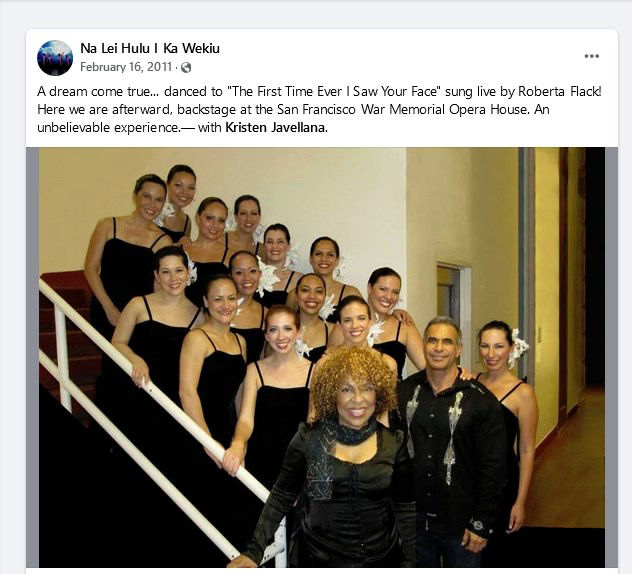
Members of Nā Lei Hulu following a performance with Roberta Flack in 2011.
from Kumu Patrick
One of our most special hālau memories was when we danced “The First Time Ever I Saw Your Face” for a Valentine’s Day concert with Roberta at the SF Opera House in 2011. During our first rehearsal she said, “I can’t watch, it’s so beautiful it will make me cry.” I thought, “I should have retired right then and there. Does it get better than that?” Mahalo, Roberta, for loving our hula so much; we were and still are utterly thrilled and honored.
We were privileged to be invited to fly to NY and dance for Roberta in her home after she was diagnosed with ALS. She found hope and inspiration in the power of art through friends who would sing and play for her. We were between Nona Hendryx and Alicia Keys.
Roberta loved hula and we would send her videos from time to time of us dancing a song for her and letting the audience show their love to this incredible artist. We shared our aloha with her in this video (featuring Jana Anguay Alcain and Roz Catracchia) from Grace Cathedral Saturday, February 22nd.
Rest in aloha, dear Roberta.
Watch our final aloha message from a showcase of The Epic Tale of Hiʻiaka at Grace Cathedral.
The free show will occur every Wednesday at 6:30 p.m. on the Kuhio Beach hula mound
HONOLULU (KHON2) — Lei Pua ʻAla Queer Histories of Hawaiʻi presented the premiere of their new hula show, “The Return of Kapaemahu,” which is based on the long-hidden story of four legendary voyagers of dual male and female spirit who brought healing arts from Tahiti to Hawaiʻi long ago.
The show will be performed weekly on the Kuhio Beach hula mound, just steps from four stones that honor the mahu healers.
The premiere took place two days after President Donald Trump declared that “there are only two genders, male and female,” saying that is “official policy of the United States government.”
Despite the president’s declaration, Native Hawaiians and Tahitians celebrated mahu people, who embodied both masculinity and femininity in spirit, as they were revered as healers and leaders.
“We in Hawaiʻi are fortunate to live in a land that not only recognizes but celebrates and honors gender diversity,” said Lei Pua ʻAla co-Director Dean Hamer. “I hope that the thousands of visitors who see this show will take that message home with them and spread it far and wide.”
“The Return of Kapaemahu” was composed and directed by Kumu Patrick Makuakane, who is the first Native Hawaiian recipient of the prestigious MacArthur Foundation Genius Award. Makuakane is noted for his contemporary choreography grounded in the fundamentals of traditional hula, which he calls “hula mua.”
The production was inspired by “Kapaemahu,” the Oscar-shortlisted animated short film by Hamer, Joe Wilson and Hinaleimoana Wong-Kalu, which revived the traditional moʻolelo and central role of mahu.
“At its core, this story is a reminder from our kupuna of how to treat people with aloha and respect even if you view them as different,” Makuakane said. “Because in the end, they’re not different. They’re your ʻohana, your friends. They’re you. Just a more fabulous version of you. And couldn’t we all use a more fabulous version of ourselves to remind us of our potential?”
“The Return of Kapaemahu” is a production put on by Lei Pua ʻAla Queer Histories of Hawaiʻi, a project designed to honor more expansive histories of gender and sexual diversity across the multicultural landscape of the islands.
“Through our work on ‘Kapaemahu’ over the past ten years, we’ve seen how empowering it can be for people who have been marginalized and erased for so long to finally be able to see themselves reflected and valued in the life and culture of their community,” said Wilson, who is also a Lei Pua ʻAla co-director.
The premiere was attended by many, tourists and locals alike. The free, one-hour show will be performed every Wednesday at 6:30 p.m. throughout 2025, weather permitting. There will be no show if Kalakaua Avenue is closed for parades or block parties.
“This extraordinary production by Kumu Patrick is a great example of visitor entertainment that’s not only enjoyable but culturally meaningful, educational and impactful,” Hamer said. “And because it is free to the public, it is a wonderful addition to the resurgence of Hawaiian cultural programs now helping to reshape the visitor experience in Waikiki.”
Additional sponsors of “The Return of Kapaemahu” include the City and County of Honolulu, Hawaiʻi Tourism Authority, Kilohana by the Council for Native Hawaiian Advancement, Waikiki Business Improvement District, Hawaiʻi Council for the Humanities and Mellon Foundation.
HONOLULU (Island News) — “The Return of Kapaemahu” presents a free hula show revealing the stories of Kapaemahu every Wednesday at Kuhio Beach.
This first-ever hula show is a “unique monument to healing and inclusion” that shares the long-hidden story of The Healer Stones of Kapaemahu. The free, one-hour show premiered this evening on the Kuhio Beach hula mound. Visitors and residents can watch this performance every Wednesday from 6:30 to 7:30 p.m. throughout 2025.
The show was composed and directed by Kumu Patrick Makuakāne, incorporating modern music which adds a new layer to the story’s poetic message. The production includes traditional hula as its foundation along with the use of the unique style that Makuakāne calls hula mua.
“At its core, this story is a reminder from our kupuna of how to treat people with aloha and respect even if you view them as different,” said Kumu Patrick. “Because in the end, they’re not different. They’re your ‘ohana, your friends. They’re you. Just a more fabulous version of you. And couldn’t we all use a more fabulous version of ourselves to remind us of our potential?”
“The Return of Kapaemahu” is a production of Lei Pua ʻAla Queer Histories of Hawaiʻi, which strives to illuminate and honor more stories that represent gender and sexual diversity across the rich, multicultural landscape of the islands.
40. We are forty years old this year. I feel like I blinked and forty years flew by. What a marvel it has been. This world according to hula. The unimaginable made tangible. A MacArthur Fellow whoʻs now an older fellow. Never crossed my mind Iʻd be either and here I am. I saw so many of you at KUPUKUPU, and again I am reminded of how love and generosity takes shape. It takes shape in your attendance, year after year (yes, I see you), and the exuberant way you go out of your way to say how much you enjoyed yourself. Your words, your unwavering support make forty feel like twenty. So Iʻm ready for another twenty years.
I hope you are too. Mahalo for being the most generous supporters a hula school could ask for. 40, letʻs go! See you there!!
Kumu Hula Patrick Makuakāne is set to breathe new life into an ancient Hawaiian legend with The Return of Kapaemahu. This groundbreaking live performance premieres on January 22, 2025, at 6:30 PM on the hula mound at Kuhio Beach in Waikīkī and will run every Wednesday throughout the year. The free, one-hour show promises a stunning blend of tradition and innovation.
Renowned for his contemporary choreography deeply rooted in traditional hula, Makuakāne introduces audiences to hula mua—a modern approach incorporating contemporary music. His vision brings a fresh perspective to the story of Kapaemahu, a tale of four legendary māhū healers of dual male and female spirit. These figures are celebrated for their wisdom, compassion, and healing abilities, as detailed in the Oscar-shortlisted animated short film Kapaemahu by Dean Hamer, Joe Wilson, and Hinaleimoana Wong-Kalu.
Makuakāne’s production delves into the nearly forgotten aspects of the moʻolelo, reclaiming and honoring this integral piece of Hawaiian history and culture. Audiences can expect dynamic choreography, captivating visuals, and a poetic message that resonates across generations.
“I hope young people see themselves in this story,” Makuakāne shared, emphasizing the universal themes of identity and acceptance. The performance is designed for all ages, ensuring that families and individuals alike can experience its profound message.
Visual elements will include video clips, photos from past performances, and artwork inspired by the animated film. These elements will further enrich the audience’s understanding and appreciation of this historic narrative.
For more information, visit queerhistoriesofhawaii.org or follow @queerhistoriesofhawaii on social media. Don’t miss this unique celebration of culture, history, and inclusivity.
Today on The Conversation, we’re sharing interviews with talented creatives in Hawai’i who have picked up some big awards in recognition of the work they do.
Kumu Hula Vicky Holt Takamine talks about winning the Dorothy and Lillian Gish Prize, which honors individuals who have “made an outstanding contribution to the beauty of the world.” | Full Story
San Francisco-based Kumu Hula Patrick Makuakāne earns national recognition as a MacArthur Foundation fellow that comes with an $800,000 ‘genius grant’ | Full Story
Filmmakers Joe Wilson and Dean Hamer discuss how a grant from the Mellon Foundation will help their project documenting queer histories in Hawaiʻi | Full Story
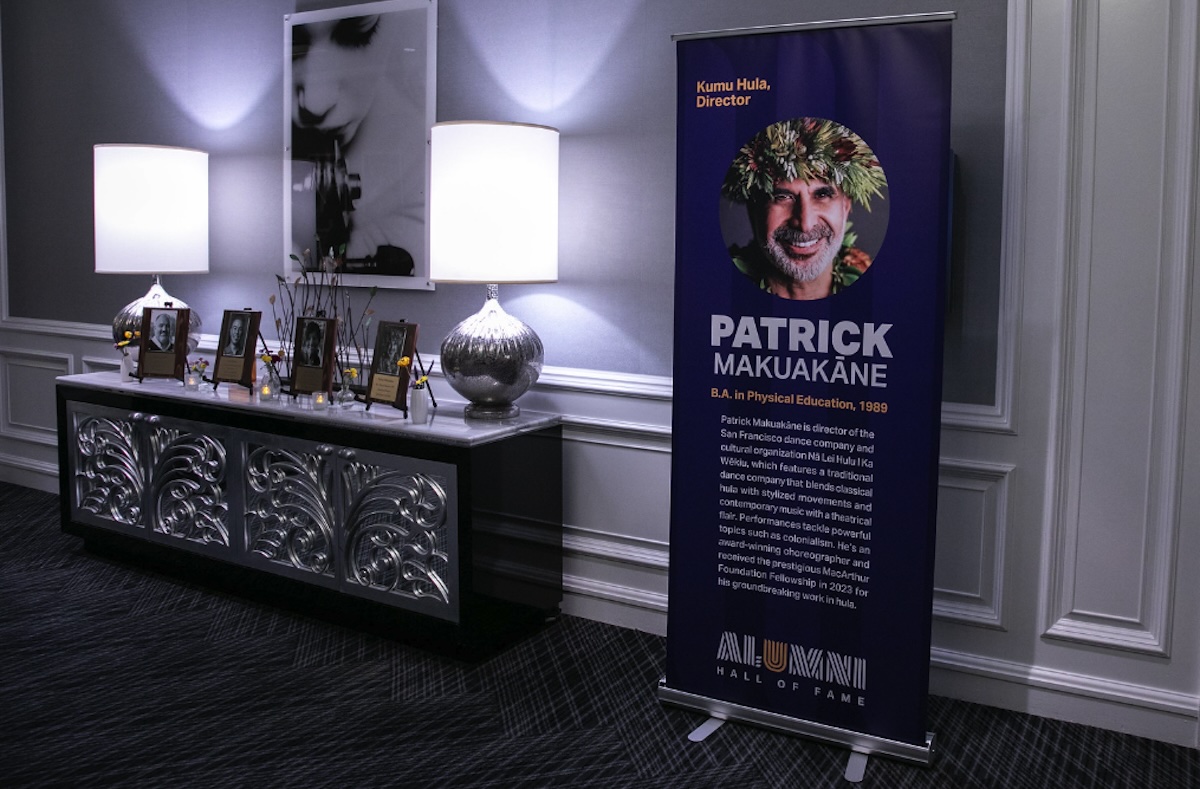
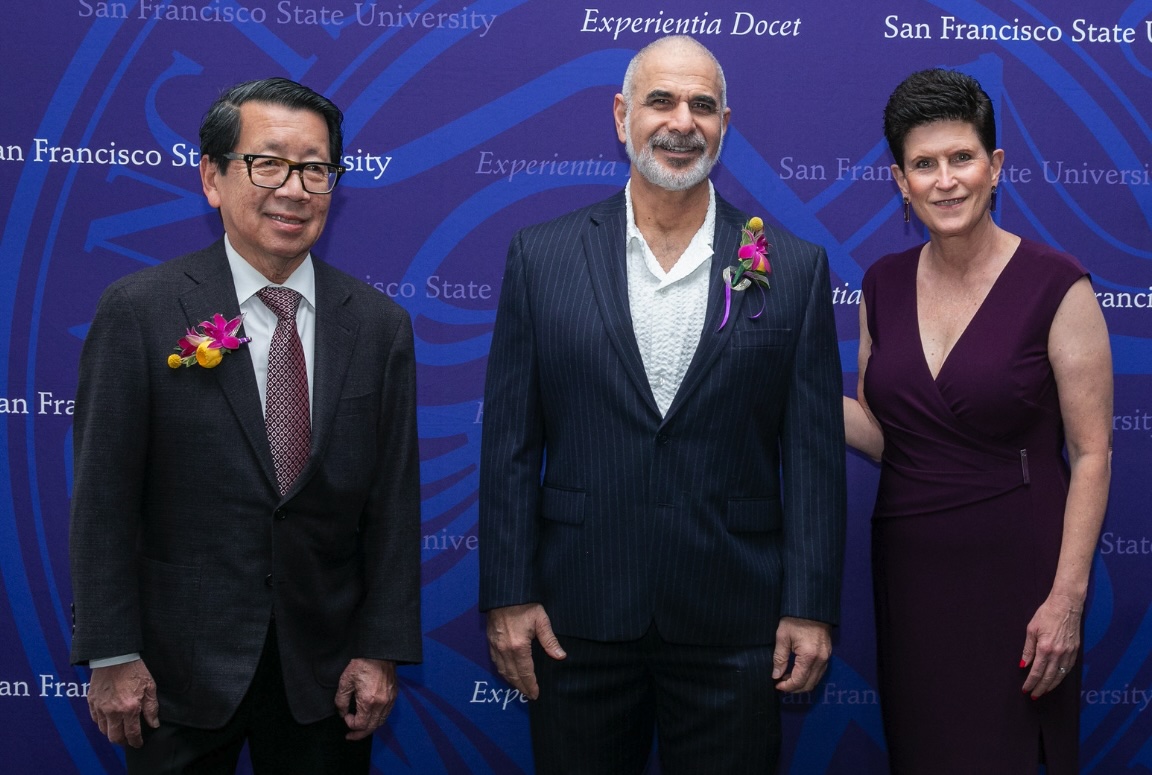
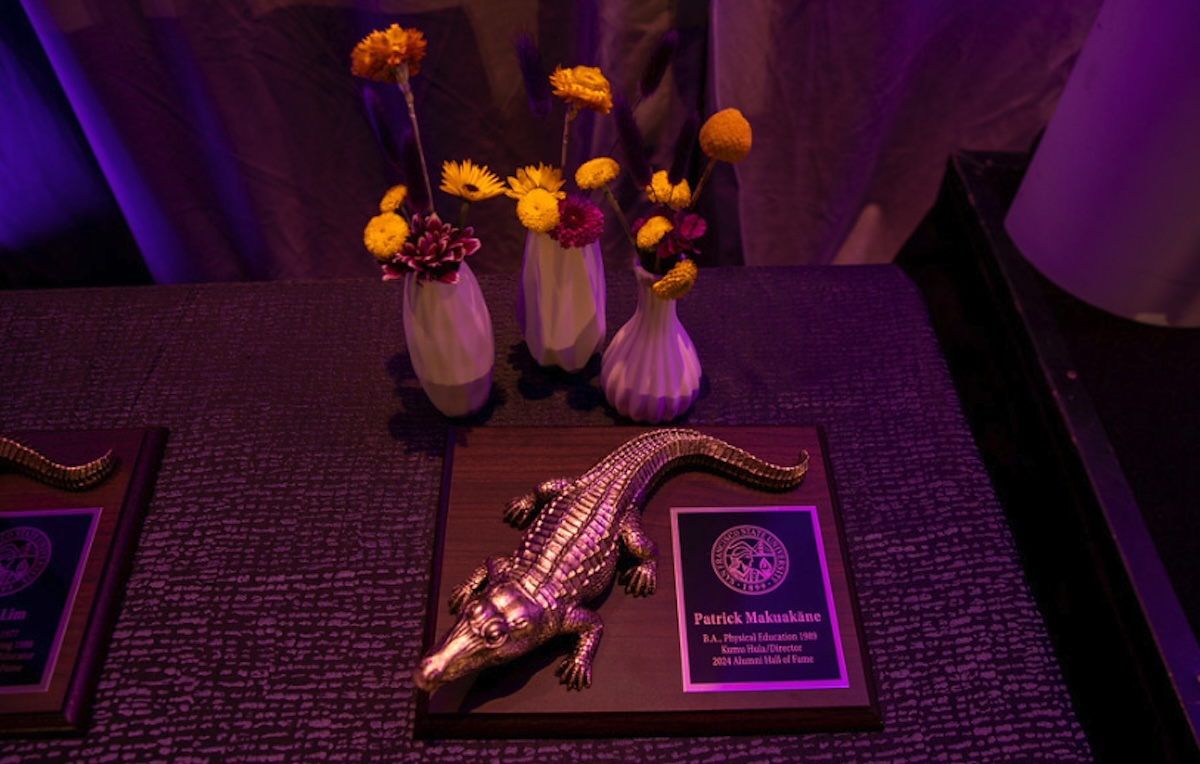
For 30 years, San Francisco State University has recognized notable alumni for their contributions to their communities, whether it’s the creation of innovative arts programs, their leadership in business or through the art they’ve made. This year’s San Francisco State Alumni Hall of Fame inductees are innovators in dance, poetry, food and health care and are also community and business leaders. SF State President Lynn Mahoney and the University community will honor the four newest inductees at a celebration and dinner Friday, Nov. 1, at The Ritz-Carlton, San Francisco.
“Each year, as we induct new alumni into our Hall of Fame, I’m impressed by the range of their accomplishments — though I’m not surprised by their success. SF State prepares students to be successful global citizens focused on problem-solving with a lens toward equity,” Mahoney said. “All our Hall of Fame alumni share a desire to leave an enduring mark through their work and in their communities. These four inductees exemplify this, and it is a pleasure to welcome them to the Hall of Fame.”
Patrick Makuakāne B.A., 1989
Patrick Makuakāne founded and oversees the cultural organization Nā Lei Hulu I Ka Wēkiu, which features a traditional dance company that blends classical hula with stylized movements and contemporary music with a theatrical flair. Raised in Honolulu, he began dancing at 13 and studied with some of Hawai’i’s most recognized hula masters. Makuakāne founded his dance school in 1985.
In 2023, he received a MacArthur “genius” grant for his groundbreaking work as a cultural preservationist. As the leader of the organization, he’s trained thousands of dancers in hula, creating and sustaining a thriving community. His productions combine traditional hula with contemporary music and movements that uplift Hawaiian culture and history while tackling powerful topics such as colonialism and Native Hawaiian transgender artists.
Over the past 39 years, Makuakāne has been honored for his work. He received a Lifetime Achievement Kulia i ka Nu’u Award from the Honolulu Chamber of Commerce of Northern California. In 2020, he was a recipient of the prestigious Hewlett 50 Arts Commission, which supports the creation and premiere of 50 exceptional works by world-class artists. The San Francisco Arts Commission presented him with a Legacy award in 2018. He is the spiritual and cultural adviser for the Native Hawaiian Religious Spiritual Group at San Quentin State Prison.
His latest projects are writing and choreographing a musical based on the epic tale of Hi’iakaikapoliopele, the youngest and favorite sister of the Hawaiian god Pele. He’s directing and choreographing the first major Hawaiian-language opera based on the life of native Hawaiian patriot Timoteo Haʻalilio, which will premiere with the Hawai’i Opera Theatre in May 2026.
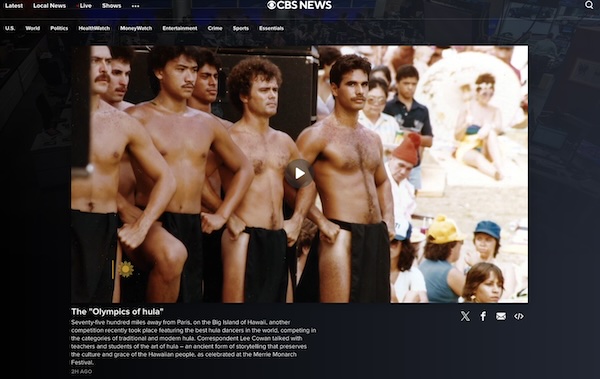
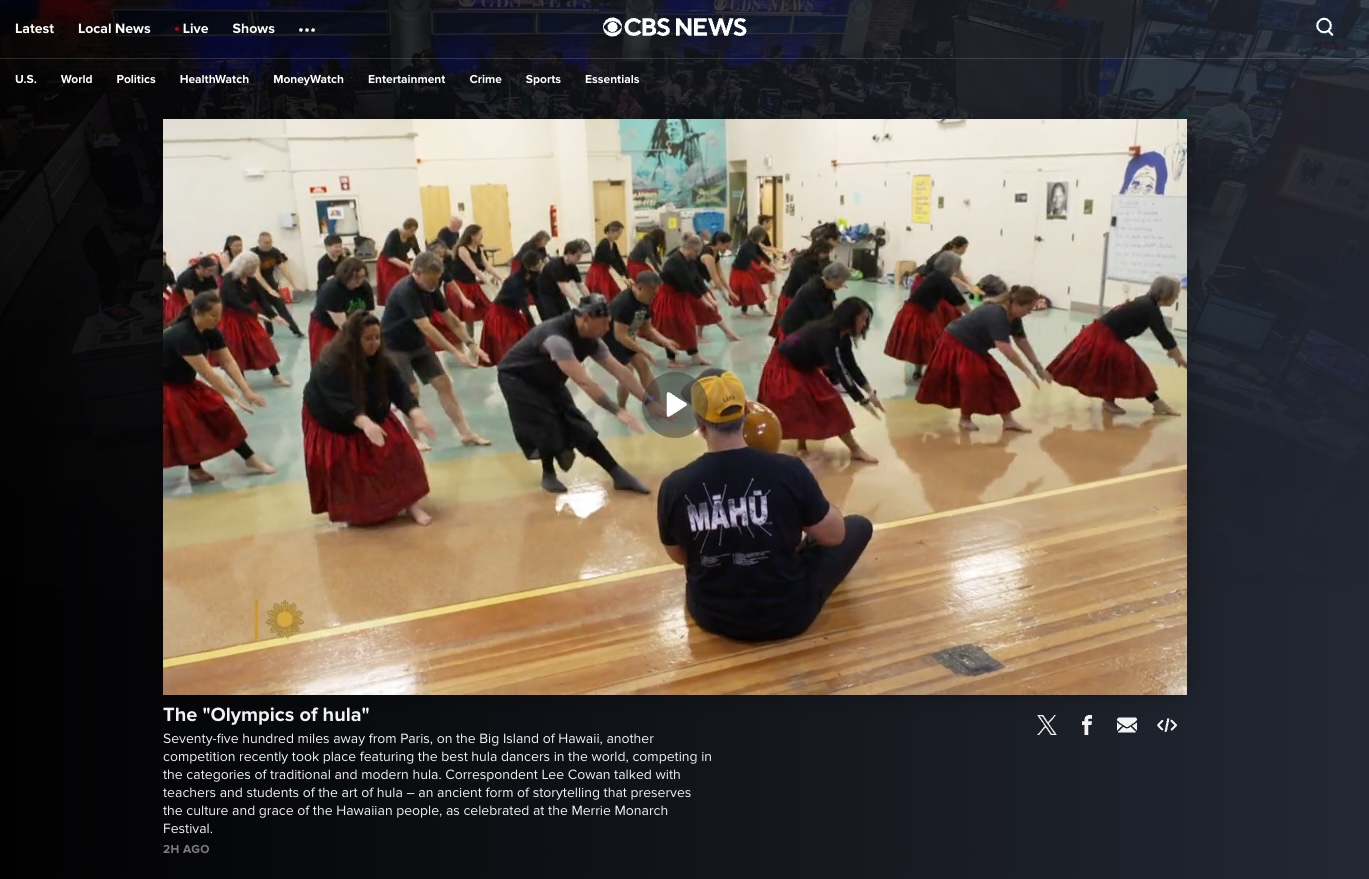
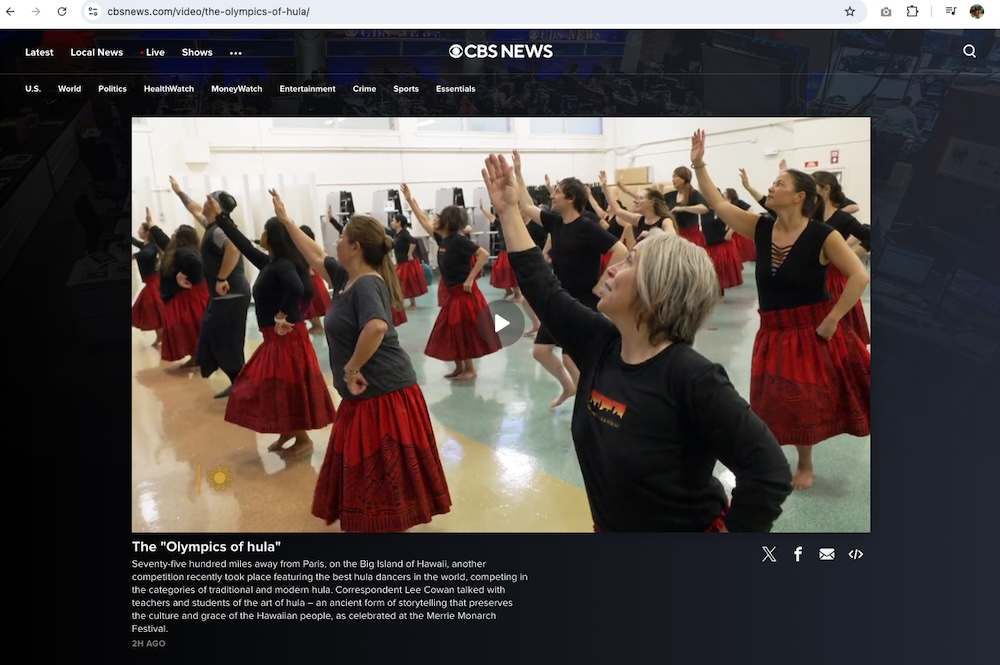
Kumu Patrick Makuakāne interviewed as part of CBS News Sunday Morning on demystifying stereotypes, and the power and elegance of hula, using the backdrop of the latest Merrie Monarch festival.
Professor of Dance Ray Tadio and alumnus Patrick Makuakāne are both winning praise for the unique ways they use traditional dance to express their cultural identities
By Jamie Oppenheim and Matt Itelson | SFSU Magazine Spring/Summer 2024
The movements of dance are found anywhere humans are on the planet. We may move differently, but we all move to the music. It tells us the stories that our ancestors wanted to know, to move with, to feel in our bones and our hearts. To keep new generations moving, an alum and a professor from SF State are preserving the dances of their respective homelands.
Patrick Makuakāne: moving hula forward
Most cultural preservationists look to traditions, artifacts, history and language to keep a culture alive and intact. But that’s where alumnus Patrick Makuakāne (B.S., ’89), a kumu hula (master hula teacher), bucks tradition. His unique interpretation of the art form, which he calls hula mua (Hawaiian for “forward”), combines sacred elements like chanting, singing and traditional choreography with modern touches like techno music and themes drawn from contemporary culture. (His show “Mahu,” performed at several Bay Area venues last year, celebrates transgender artists.)
His groundbreaking work in hula at the San Francisco dance school he founded in 1985 earned him a 2023 MacArthur Fellowship in cultural preservation, a recognition that came with a generous stipend of $800,000. He’s the first native Hawaiian to receive the honor, and he was among 19 other fellows from more traditional disciplines such as science, poetry, art, law, music and math.
The 62-year-old has made it his mission to challenge what’s considered traditional. “When people think of tradition, they view it as fixed or immobile,” he says. “You can still preserve culture and innovate at the same time. They’re not mutually exclusive pursuits. In fact, if your culture does not innovate or evolve then it becomes immobile and a dead culture.”
A raconteur, Makuakāne tells both old and new stories through hula. Traditional hula dances focus on the land and the Hawaiian people, but his choreography touches on edgier topics like imperialism and occupation. His 1996 production “The Natives Are Restless” explored the tragic history of Hawaii’s transformation from a sovereign monarchy to being annexed by the United States, which had overthrown the island nation’s first and only queen.
“I did this piece called ‘Salva Mea,’ which was about the missionaries. I dressed as a priest with techno music in the background and I was running around the stage with an 8-foot cross baptizing people,” he says. “It was like an incoherent, messy and incautious mix of tradition and experimentation that really worked. … People were blown away.”
That production set him on a path of experimentation ever since.
Winner of the MacArthur ‘genius’ grant in 2023 has forged his own style in San Francisco while often subverting stereotypes of hula itself
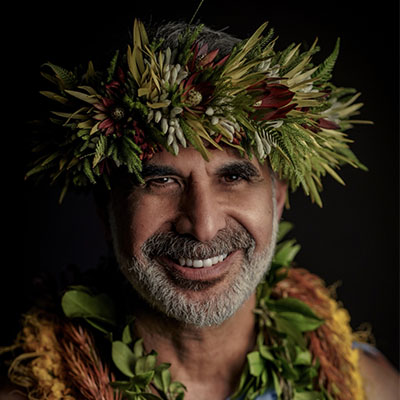
For Patrick Makuakāne, hula isn’t just a way to preserve his Native Hawaiian heritage. It’s also a way to create something new.
As the visionary leader of the San Francisco-based hula school and dance company Nā Lei Hulu I Ka Wēkiu since 1985, Makuakāne has forged his own style of hula that blends traditional movements and chants with contemporary music, costumes and themes such as colonialism, sovereignty and gender fluidity – while often subverting stereotypes about hula itself.
Makuakāne’s hula mua (“hula that evolves”) has included performances such as Salva Mea, a collective dance set against progressive house music that depicts the devastation Christian missionaries caused in 19th-century Hawaii and long-form narrative pieces like Māhū, a collaboration with Hawaiian transgender guest artists that spotlights the respect given to third-gender people in ancient Hawaii society. He’s also created hula to Roberta Flack’s The First Time Ever I Saw Your Face and Tony Bennett’s I Left My Heart in San Francisco.
For this work as a kumu hula, or master hula teacher, the MacArthur Foundation named Makuakāne a 2023 fellow, often known as the “genius” award.
Makuakāne believes we need to reframe the conversation around tradition as being something immobile because “traditions morph and change depending on the environmental influence”. He sees himself as preserving the traditions of Hawaii’s culture as well as its innovations, something he believes is only possible in a place like San Francisco, which he calls “a good place to experiment”.
The Nā Lei Hulu I Ka Wēkiu dance company in 1996, getting ready to perform The Natives Are Restless, its first full-evening production. Photograph: Terry Lee/Courtesy of Patrick Makuakāne
“If I was in LA or New York, or even Hawaii, I would not be getting this [MacArthur Foundation] award,” he said. “There’s something special about weird and wonderful San Francisco that allows me to really think about hula on another level.”
University of Michigan professor Amy Stillman, a historian of Pacific Islands performance traditions, agrees. “I really think a big part of why Patrick has achieved what he’s achieved is because he’s not in Hawaii,” said Stillman, a two-time Grammy award winner for best Hawaiian music album. “There’s a huge Hawaiian community up and down the whole west coast, so he has a community looking over his shoulder, but not breathing down his neck. He doesn’t have the tradition police reining him in.”
Stillman said she was always excited to see something new in the world of hula because it speaks to a fearlessness to experiment. “Patrick’s experiments, for me, are always aesthetically off the charts,” she said. “It’s not just the dancing, but the costuming, the staging, the lighting, the presentation – he’s really a holistic artist in that sense.”
In past decades, there was what Stillman described as a “freezing effect” in regards to hula. “Tradition was something to be mummified,” she said. “Patrick was part of the vanguard that believed that we didn’t have to be held to only what we have received.”
Although the dance and arts community in San Francisco has been aware of Makuakāne’s unique artistry for years, he was shocked to learn that the MacArthur Foundation was aware as well. But when it came time for Makuakāne to receive one of the biggest phone calls of his life, he was in the remote Nevada desert without cellular service for the Burning Man festival.
“A random text somehow snuck in that someone from the MacArthur Foundation was trying to reach me about an important time-sensitive matter,” said Makuakāne, who ended up trapped at the site for days since heavy rains had made the road out impassable. “I’m thinking, what the hell are they calling me for?”
So Makuakāne left his camp and hiked through thick mud to get to the rangers station where he could access wifi, but when he returned the foundation’s call, no one answered. It wasn’t until days later, once he got back home to San Francisco, that the 62-year-old learned the news.
Makuakāne, who will receive a no-strings-attached $800,000 grant, said he hopes to use some of the award to move back to Hawaii for a couple of months to collaborate with other cultural practitioners he admires.
Born and raised in Honolulu, Makuakāne describes his father as “pure Hawaiian” and his white mother as “pure Philadelphia”. He was first exposed to hula at age 10, during a one-week cultural exploration camp hosted by a local school. There, he learned Hawaii sports, games, singing and philosophy.
“It filled me up, but the one class I hated was hula,” Makuakāne said. “It was mostly because the instructor was a flamboyant gay man and it scared me. That was my own internalized homophobia.” Makuakāne would later come out as gay himself.
When Makuakāne got to high school, he joined the Hawaii club because he wanted to sing, but he didn’t want to dance hula. His renowned teacher, John Keola Lake, told him otherwise. “In this club, you dance hula and you sing, and if you don’t like it, there’s the door,” he recalled Lake saying.
After two weeks, a teenaged Makuakāne was hooked. “Hula was the portal that opened the door for me to express myself as a Native Hawaiian man,” he said. “I knew from then on that this was going to be my life.”
Makuakāne later joined an all-male hula school owned by the Hawaii music icon Robert Cazimero, which was groundbreaking at the time because hula was still thought of as a domain for women. “I saw them dance and it was beyond imaginable what men could do with hula,” said Makuakāne. “It was incredibly athletic, graceful and artful.” He stayed with the group for about 10 years.
In 1985, love brought Makuakāne to San Francisco. He thought he’d last about a year in the city before going back to the islands, but he realized he could stay connected to his heritage and form a new community on the mainland through hula.
Since opening his own school more than 35 years ago, he’s taught hula to thousands of students from northern California who are connected to Hawaii in some way, while others have no real ties to the islands but they appreciate the multilayered art form. He’s quick to encourage anyone to come to class, even if they aren’t Hawaiian. “The hula schools in Hawaii are just as mixed as the hula schools here,” he said.
After beginning intensive traditional studies in 2000 with legendary hula teacher Mae Kamāmalu Klein in Hawaii, Makuakāne was named a kumu hula in 2003. “The easiest thing for people to understand is that I’m a hula teacher, but it’s way more than that because when I think of the relationship I have to my kumu, it is the most reverential relationship I have in my life. It outranks any other relationship that I have with anyone else.”
When the Maui wildfires broke out in early August, people grieved for the Native Hawaiian cultural losses in addition to the tragic deaths. “The reason for a lot of what’s happened in Hawaii is we’ve moved away from the sustainable way of living that was part of our culture,” said Makuakāne. “That’s because of western civilization, the tourism industry, making way for golf courses and diverting water from fish ponds. If anything, what I hope [the fire] does is provide us an opportunity to restart and think of ways we can make Lahaina the fertile place that it once was.”
For people grieving losses from the Maui fires or anything else for that matter, hula can be a healing practice, according to Makuakāne. “When you’re in community and you’re dancing and you’re responsible for one another, there’s a healing, loving aspect to that,” he said. “I consider hula my church because hula was always on Sundays. I tell people if they’re sad to come to hula and feel its healing energy.”
In addition to being a kumu hula at his school, Makuakāne serves as a spiritual and cultural adviser for the Native Hawaiian Religious Group at San Quentin state prison. “It was really one of the most uplifting and heart-rending and fulfilling experiences of my life teaching these guys and to see them coming to themselves and see them value this as a place of community,” he said.
“In hula, the wide spectrum of human emotions is covered. It’s really encompassing; I’m still learning, even 50 years into it. And I love it.”
Patrick Makuakāne is the first native Hawaiian to receive the prestigious “genius grant”
Most cultural preservationists look to traditions, artifacts, history and language to keep a culture alive and intact. But that’s where alumnus Patrick Makuakāne (B.S., ’89), a kumu hula (master hula teacher) bucks tradition. His unique interpretation of the art form, which he calls hula mua (Hawaiian for “forward”), combines sacred elements like chanting, singing and traditional choreography with modern touches like techno music and themes drawn from contemporary culture. (His show “Mahu,” performed at several Bay Area venues this year, celebrated transgender artists.)
“In Hawaiian there’s a word called kuleana, which means your responsibility, what you bring to the table — something that’s unique and special that you do that uplifts your world,” he told the MacArthur Foundation. “Our ancestors were highly innovative people. What I’m doing with innovating in hula is keeping that innovative spirit of our ancestors and my kuleana.”
His groundbreaking work in hula at the San Francisco dance school he founded in 1985 earned him a 2023 MacArthur Fellowship in cultural preservation, a recognition that comes with a generous stipend of $800,000. He’s the first native Hawaiian to receive the honor, and he was among 19 other fellows from more traditional disciplines such as science, poetry, art, law, music and math.
The 62-year-old has made it his mission to challenge what’s considered traditional. “When people think of tradition, they view it as fixed or immobile,” he said. “You can still preserve culture and innovate at the same time. They’re not mutually exclusive pursuits. In fact, if your culture does not innovate or evolve then it becomes immobile and a dead culture.”
A raconteur, Makuakāne tells both old and new stories through hula. Traditional hula dances focus on the land and the Hawaiian people, but his choreography touches on edgier topics like imperialism and occupation. His 1996 production “The Natives Are Restless” explored the tragic history of Hawaii’s transformation from a sovereign monarchy to being annexed by the United States, which had overthrown the island nation’s first and only queen.
“I did this piece called ‘Salva Mea,’ which was about the missionaries. I dressed as a priest with techno music in the background and I was running around the stage with an 8-foot cross baptizing people,” he said. “It was like an incoherent, messy and incautious mix of tradition and experimentation that really worked. … People were blown away.”
That production set him on a path of experimentation ever since.
Hula often shies away from tough topics, he says, but hula is the right art form to tell these stories so that history doesn’t repeat itself. He credits San Francisco with being the perfect place for his art, a city known as a playground for experimentation, subversion and boundary pushing. Makuakāne arrived in the city around the time of Act Up, a grassroots political group working to end the AIDS epidemic. The group was known for its theatrical acts of civil disobedience, actions he calls influential.
He began studying hula at 13 years old. At 23, he moved to San Francisco for love — he followed a boyfriend who was a waiter at an exclusive French restaurant. After arriving in the city, Makuakāne taught hula to earn money. It was also his tie to Hawaii. He quickly attracted students and founded his award-winning hula school Nā Lei Hulu I Ka Wēkiu (which means “many-feathered wreaths at the summit”). Over the past four decades, he estimated he’s taught thousands of students.
While he was building up his dance company, he studied Kinesiology at San Francisco State University. After graduating he continued teaching hula and working as a physical trainer. As his school grew, he devoted himself full-time to hula, a decision that’s paid off.
He was at Burning Man when he got the call from the MacArthur Foundation. He had no cell phone service and wasn’t sure why they called him. When he finally connected with the organization five days later, he was shocked. As the surprise wore off, guilt surfaced. So much of his work is entrenched in community and rests on the shoulders of his ancestors. “There are many people in my position who are deserving of an award such as this,” he said. “So, you do feel a bit guilty. Why me? Why not somebody else? How did I get noticed, you know?”
But then again, he has been at this for more than three decades and he’s one of only few taking hula in new directions. And he’s grateful to be in the perfect place to do it.
“[A friend once said,] “‘It must be nice being in San Francisco without someone looking over your shoulder, critiquing your every move.’ I was like, ‘Yeah it is,’” he said. “So that sense of liberation in your arts, feeling unshackled and doing whatever you want was a part of my process. I feel like I’m at a place really where I can do anything.”
Kumu hula Patrick Makuakāne has been transforming lives for decades. Now, the MacArthur Foundation is changing his with its fellowship award.
Many may remember Burning Man 2023 for the relentless showers that turned Nevada’s Black Rock Desert into a mud-soaked mess and left tens of thousands of artsy, counterculture types temporarily stranded.
Among the throng caught smack dab in the middle of those saturated and unpleasant conditions was Patrick Makuakāne. But his memory of the festival is assuaged by the fact that not even a torrential downpour could rain on his parade — not when he was about to be showered with one of the greatest honors of his life.
As the distinguished kumu hula and cultural preservationist recollects, it was amid the deluge that he received an unexpected droplet from heaven — dew that descended in the form of a voice message from the MacArthur Foundation.
“I’m thinking, ‘What is the MacArthur Foundation calling me for? Do I owe them money?’” recalls Makuakāne with a chuckle.
On the contrary, the news was that he had been named a 2023 MacArthur Fellow and, as part of that distinction, he was to be gifted a generous amount of cash — specifically, $800,000 paid in quarterly installments over the next five years — to continue expanding upon what he already does so well in the hula cosmos.
Colloquially referred to as “the genius grant,” the yearly MacArthur award celebrates individuals who demonstrate exceptional creativity in their work through “no-strings-attached fellowships.” While recipients’ past accomplishments are taken into account, the honor ultimately is an investment in those who show “originality, insight and potential,” according to the foundation’s website.
Naturally, Makuakāne was thrilled to receive such a prestigious honor.
“How do you even begin to bring that into your world?” he says. “I know what I’m doing here in San Francisco is my little slice of life. I’ve developed a nice world of teaching hula, it’s been successful, I love it and I’m happy.
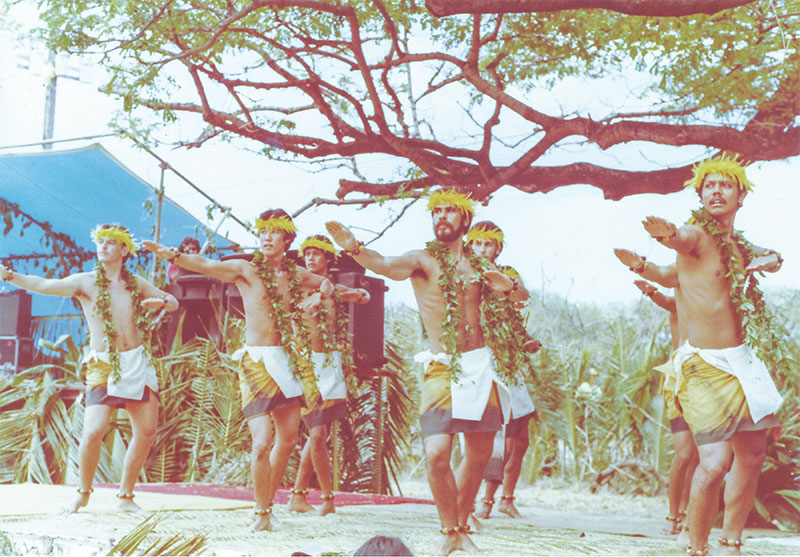
Makuakāne performs with Hālau Nā Kamalei in 1983. PHOTO COURTESY PATRICK MAKUAKÅNE
“But you don’t expect anyone from MacArthur Foundation to hear about it.”
The affable kumu finds humor in being grouped with 19 other honorees — among them a computer scientist and statistician, a cellular and molecular biologist, an environmental engineer and a U.S. poet laureate.
“I joke about that — oh, this year’s winners are environmental attorneys, legal scholars … and a hula dancer!” quips the man who often refers to himself as “the world’s most imperfect kumu hula.”
Yet even he recognizes the crucial societal role he plays in elevating others through the power of hula.
“MacArthur Foundation figured out it’s all just the same, too, because hula is as important as all the other activities that the scholars are doing,” acknowledges Makuakāne. “Hula is transformative. I’ve seen firsthand how it changes people’s lives, what it’s done for mine. So, I understand what hula is, what it can be, and what culture and community can do for individuals.”
For the 62-year-old master teacher, providing people with a secure location to gather and express themselves is what still motivates him after decades of dancing and promoting his craft.
“I’ve been doing hula for almost 50 years and what I’ve come to understand, especially here in San Francisco, is that, yes, culture is important and so is dance,” he says. “But the most important thing about what I do is developing and providing community, a safe place for people to be acknowledged, a place where everyone feels welcome but where everyone also puts in the work to ensure that we move forward.
“It’s not easy to develop all these qualities. But when it works, it works really well. As a community, we can do so much. I mean we’re a juggernaut if we’re all putting our minds together to complete a task.”
The overpowering force Makuakāne is referring to is his dance company, Nā Lei Hulu I Ka Wēkiu, which has been a staple of the San Francisco scene for nearly four decades. Yet the master teacher admits its birth was one of circumstance rather than intention. Back in 1985, he and his partner relocated to the city by the bay to open “a real fancy French restaurant,” yet Makuakāne believed their stay there would be temporary.
“We were going to save money and then move back to Hawai‘i because I wasn’t going to leave hula, although I could do it for a year,” he explains. “But after a couple months, I was like, ‘I kind of like it over here.’”
To better cope with being away from the islands, Makuakāne decided to offer hula lessons. Almost immediately, people began signing up for his classes.
“It was a way for those people who had left Hawai‘i to stay in touch with Hawai‘i. All these people who never thought of taking hula when they were at home, they weren’t even interested in it, but now this was a vehicle for them to remain in touch with their culture,” he explains.
In many ways, the very liberated and progressive Bay Area was the perfect haven for Makuakāne to plant roots and explore his creative side.
“I’d say that San Francisco unshackled me whereas Hawai‘i always kept me bound to our traditions,” he asserts. “It was like you could do almost anything in this city and people would support you.
“That was the beginning of me flexing my creative muscles.”
Since then, Makuakāne — who sees himself as both a cultural preservationist grounded in long-established customs and a maverick unafraid of exploring new territory — has shined through an evolving style he refers to as “hula mua,” which blends traditional hula with contemporary art forms. By combining his own unique take on the dance with theatrical staging and innovative choreography, he’s been able to create a smorgasbord of shows at venues from San Francisco to Hawai‘i, New Orleans to New York, tackling hot-button topics such as colonialism and sovereignty with The Natives Are Restless (1996), and gender fluidity in Hawaiian culture with Māhū (2022).
Along the way, he’s found time to work as a spiritual and cultural adviser for the incarcerated, giving inmates at San Quentin State Prison something to believe in as an evangelist of sorts for hula. He’s also accumulated his share of honors, including the Hewlett & Gerbode foundations’ Choreographer Commissioning Award for Ka Leo Kanaka (2012), the Native Arts & Cultures Foundation’s Artist Fellowship (2014), and a slew of Isadora Duncan Dance Awards, or Izzies, highlighted by Best Company Award (2010) for the Roberta Flack classic The First Time Ever I Saw Your Face.
In fact, Flack was so impressed with the dance company’s rendition of her song that back in January, she requested a live performance at her home in Utah. Makuakāne agreed, if only to pay tribute to the legendary artist who’s currently battling Lou Gehrig’s disease.
“She’s in dire straits … the only way she’s keeping her spirits and hopes alive while she’s in this debilitating state because she cannot eat, she cannot talk … is through art. It keeps her alive now,” he says.
The 30-minute set, which consisted of Makuakāne and six of his dancers, turned out to be a memorable one for the venerable kumu hula.
“Roberta was so gracious … it was a moment,” he notes. “What a huge honor that was.”
When Makuakāne was 10, he got his first taste of hula during an Explorations class at Kamehameha Schools, and immediately rejected it.
It wasn’t because he found the dance form displeasing; rather, hula made him uncomfortable about his own identity. As a result, he laid his internal conflict at the feet of his kumu, an openly gay man.
“I was looking at him and thinking, ‘That’s how I goin’ become — a sassy, big muffy, too?” recalls Makuakāne, who was raised in Kaimukī and attended nearby St. Patrick and Saint Louis schools.
“Looking back, it was my own internal homophobia, and because I hadn’t come out yet, I was thinking, ‘The whole world will know I’m māhū!’” he continues. “But I laugh about this now because I came to love this person for his muffiness, for his flamboyance — I celebrate that. But back then, it was all about me being scared of it.”
Makuakāne’s rejection of hula eventually ended at Saint Louis after kumu hula John Keola Lake didn’t take kindly to the youngster’s demand of “only singing Hawaiian songs and not dancing the hula.”
“He looked at me and said, ‘In this club, you dance hula and you sing, and if you don’t like it, there’s the door!’” recounts Makuakāne, who sheepishly agreed to the rule.
Two weeks later, he was fully converted to the dance form.
“It just grabbed me in a way that I knew I was going to be doing it for the rest of my life,” confesses Makuakāne, who later studied hula under Robert Uluwehi Cazimero and Mae Kamāmalu Klein.
“But I also knew that I was going to eventually be teaching it, too.”
Based on all the accolades he’s received and the thousands of lives impacted over his career, it’s safe to say that many are grateful for Makuakāne’s willingness to be “hooked” by hula and ultimately share his love of the Hawaiian culture with others.
As for what lies ahead, he acknowledges that he’ll soon have to decide how to use the “exorbitant amount of money” from MacArthur Foundation.
One idea he’s kicking around is collaborating with several Native Hawaiian artists whose work he admires, and coming up with projects “that’s inspired by what they do.”
A second goal is a bit more self-serving but necessary to transform his home life.
“What’s important to me is finally having a bathroom that a gay man in his 60s deserves, gunfunnit!” he says with a bit of sass. “It’s like a friggin’ closet. Can I at least have one that’s as big as two closets?!”
Manuel Muñoz is the son of immigrant farm laborers from California’s Central Valley whose four works of fiction center the lives of Mexican-American communities in the region. Patrick Makuakane is a native Hawaiian and San Francisco-based kumu hula, or master teacher, who created a unique form of hula that blends traditional movements with contemporary music. They’re among five Californians who have been awarded the MacArthur Fellowship this year. We talk to them about what the award means to them and their communities and how themes of love, class, sexuality and identity suffuse their art.