HONOLULU – To foster meaningful cultural experiences in Hawai‘i’s visitor hubs, the Hawai‘i Tourism Authority (HTA) is investing $397,000 in seven Hawaiian cultural programs and practitioners through its Ho‘okipa Malihini Initiative. Hoʻokipa malihini means to “welcome guests” and true to its name, this program funds projects that enhance the visitor experience while fostering meaningful interactions between residents and visitors in resort areas and harbors statewide.
“The Ho‘okipa Malihini initiative supports Hawai‘i’s host culture while enhancing the experiences of our guests,” said Caroline Anderson, interim president and CEO of HTA. “These programs are an essential part of how we ensure that the values, traditions, and stories of our people remain at the forefront of Hawai‘i’s visitor experience.”
Funding supports Hawaiian programs and cultural practitioners, including craftspersons, musicians, linguists and other artists. These practitioners offer regularly scheduled, free entertainment and cultural awareness programming in designated resort areas and harbors. The Hoʻokipa Malihini program is an HTA destination stewardship program administered through a partnership with Kilohana, a division of the Council for Native Hawaiian Advancement.
A committee of community leaders, industry experts, business representatives, and Hawaiʻi Tourism Authority staff, representing each island, evaluated proposals for events happening across the state from July 1, 2025, through June 30, 2026. The committee selected the following seven programs based on cultural impact, community engagement, organizational capacity and feasibility. Priority was given to efforts that best support Hawaiian culture, natural resources, local communities and responsible tourism marketing.
The Kūhiō Beach Hula Show and Torch Lighting offers free, authentic Hawaiian music and hula performances by top hālau hula on select Saturdays and Tuesdays. Held outdoors at the Kūhiō Beach Hula Mound, the show welcomes locals and visitors with casual seating and a vibrant cultural experience. Organization: Aloha Week Hawai‘i.
The Aloha Greeting and Cultural Program transforms routine cruise ship arrivals into a moment of genuine cultural connection. It offers authentic, Native Hawaiian-led welcome ceremonies that feature hula, mele (song), cultural talks and teachings on ocean stewardship. Organization: Kona Coast Heritage Foundation-Destination Kona Coast.
The Hilo Gateway Information and Hawaiian Culture Program presents Hawaiian music, cultural demonstrations and live hula performances in the heart of historic Downtown Hilo, creating an unforgettable venue for visitors to shop, dine and experience the rich layers of Hawai‘i’s culture, past and present. Organization: Destination Hilo Foundation.
The Hilo Harbor Pier Greetings Program welcomes cruise ship passengers with authentic Hawaiian music as they step onto Hilo Pier and then inspires them to explore downtown Hilo through personal interactions and information at the Aloha Information Center. Organization: Destination Hilo Foundation.
Maui Ola: Cultural Practitioner Initiative presents live cultural performances by Maui-based practitioners — musicians, hula dancers, weavers and storytellers — to resort venues on Maui and Oʻahu. It ensures these artists are compensated while sharing authentic Hawaiian traditions through mele, hula and hands-on demonstrations. Organization: Kāhuli Leo Leʻa.
The Return of Kapaemahu, directed by Kumu Hula Patrick Makuakane, brings to life the story of four māhū who sailed from Tahiti to bring healing arts to Hawai‘i. The weekly live hula performances at the Kūhiō Hula Mound foster respect for long-suppressed Hawaiian traditions while deepening understanding of Hawai‘i’s history, culture and values. Organization: Na Lei Hulu I Ka Wekiu.
Waikīkī By Moonlight features traditional mele and hula celebrating Waikīkī’s rich history and cultural significance. Each week, Waikīkī by Moonlight brings traditional mele (song) and hula performances that celebrate the story of Waikīkī to the Kūhiō Beach Hula Mound. Performances are free and open to the public. Organization: Hawaiian Music Perpetuation Society.
HONOLULU (KHON2) — A new hula show in Waikīkī brings a centuries-old story home to the very place it began. Just steps from the sacred healer stones of Kapaemahu, “The Return of Kapaemahu” tells a moʻolelo of healing, duality and aloha through traditional hula.
The free outdoor performance takes place every Wednesday from 6:30 to 7:30 p.m. under the banyan tree at the Kūhiō Beach Hula Mound.
Located on the beach side of Kalākaua Avenue near the Duke Kahanamoku Statue, the show invites both visitors and locals to sit on the grass, relax and experience the story where it happened.
“We in Hawaiʻi are fortunate to live in a land that not only recognizes but celebrates and honors gender diversity” said Lei Pua ʻAla co-director Dean Hamer in opening remarks at the premiere. “I hope that the thousands of visitors who see this show will take that message home with them and spread it far and wide.”
A moʻolelo of healing and legacy
The story began long before the 1500s, when four Tahitian healers — Kapaemahu, Kapuni, Kinohi and Kahaloa — arrived in Waikīkī from Moaulanuiakea, Raiatea. Known as māhū, individuals of both male and female spirit, the healers were celebrated for their gentle nature and miraculous cures.
When they prepared to leave, the healers asked that four large stones be placed to mark their presence, two at their home and two at their bathing site. The stones, quarried from Kaimukī, were set on the night of Kāne. The healers performed prayers and fasting for a full moon cycle, then vanished.
According to oral tradition recorded in 1906 and published the following year, their mana lives on in the stones. The site remains a tribute to healing and inclusion.
“At its core, this story is a reminder from our kupuna of how to treat people with aloha and respect even if you view them as different,” said Kumu Patrick. “Because in the end, they’re not different. They’re your ‘ohana, your friends. They’re you. Just a more fabulous version of you. And couldn’t we all use a more fabulous version of ourselves to remind us of our potential?”
Hula in the shadow of the stones
The show is composed and directed by Patrick Makuakāne, the first Native Hawaiian recipient of the MacArthur Foundation Genius Award.
“This extraordinary production by Kumu Patrick is a great example of visitor entertainment that’s not only enjoyable but culturally meaningful, educational, and impactful. And because it is free to the public, it is a wonderful addition to the resurgence of Hawaiian cultural programs now helping to reshape the visitor experience in Waikīkī,” added co-director Hamer.
Lei Pua ʻAla Queer Histories of Hawaii and Hawaii LGBT Legacy Foundation invite the public to the unveiling and dedication of a new plaque celebrating the history of Queen’s Surf Beach in Kapiolani Park on Wednesday.
What You Need To Know
The June 4 ceremony begins at 4 p.m. and will include remarks by Mayor Rick Blangiardi, community elders and special guests
Kumu Patrick Makuakāne will conduct a blessing followed by an ʻawa ceremony and picnic on the lawn
Queen’s Surf Beach was a popular gathering spot for Hawaii’s diverse LGBTQ+ Māhū communities in the 1970s, and by 1974, it became the site of the first gay pride celebration in commemoration of the 1968 Stonewall Revolt in New York
Created by Lei Pua ʻAla Queer Histories of Hawaii, the Queen’s Surf Beach plaque is the newest in a series of physical and digital historical markers to document and memorialize gender and sexual diversity across Hawaii’s multicultural landscape
The June 4 ceremony begins at 4 p.m. and will include remarks by Mayor Rick Blangiardi, community elders and special guests. Kumu Patrick Makuakāne will conduct a blessing followed by an ʻawa ceremony and picnic on the lawn.
Queen’s Surf Beach was a popular gathering spot for Hawaii’s diverse LGBTQ+ Māhū communities in the 1970s, and by 1974, it became the site of the first gay pride celebration in commemoration of the 1968 Stonewall Revolt in New York.
“Queen’s Surf provided a sense of community and family for many young people who were not accepted by their own families,” said Sina Sison in a release. Sison is a respected community advocate who was a Queen’s Surf regular in the 70s and 80s. “It was a place to learn about Hawaiian culture and traditions and make friends with people from across the islands and around the world.”
Unlike other gay beaches in the area, Queen’s Surf was highly visible to the public symbolizing Hawaii’s generally more accepting environment. Everyone was welcome at Queen’s.
Bill Char was another Queen’s Surf regular and a master lei maker who was named a Living Treasure of Hawaii this year. “Saturday night, we’d play volleyball all day, until they shut the lights off. We would sleep down at the beach so that the next morning when we woke up, we could take a shower right there, brush our teeth and be back on the court.”
Created by Lei Pua ʻAla Queer Histories of Hawaii, the Queen’s Surf Beach plaque is the newest in a series of physical and digital historical markers to document and memorialize gender and sexual diversity across Hawaii’s multicultural landscape.
“The aim of our work is to make the lives and experiences of LGBTQ+ Māhū folks, who have always been part of Hawaii’s story, more visible, because being seen and understood increases possibilities for being accepted and valued in the place you call home,” said project co-director Joe Wilson.
“We had no idea we’d be doing this work at a time when queer lives, and queer stories, are quite literally being erased from the public record,” added project co-director Dean Hamer. “We’re fortunate to be living in a place where our government is working with us instead of trying to eliminate us or pretend we don’t exist.”
The historical marker is a plaque mounted on a large stone selected by master craftsman Keoni Mossman, whose connection to the site comes through his uncle Sterling Mossman, the “hula cop” famous for entertaining at the Barefoot Bar at Queen’s Surf in the 1950s and 60s. The Queen’s Surf Restaurant and Bar were demolished in 1972 to make way for a public beach.
The new marker is intended to inspire current and future generations to “reclaim and reactivate the beach.” This includes The Māhūi, a group of young cultural advocates who are part of the Hawaii LGBT Legacy Foundation.
“For decades, Queen’s Surf provided a safe space for fellowship, cultural activities, sports and storytelling,” said Legacy Foundation Executive Director Randy Soriano. “To honor the history of this place and connect generations of queer people, our Māhūi has centered monthly community gatherings and our annual Pride kick-off picnic at the site, recreating the energy that once regularly filled this beach.”
Lisette Marie Flanary’s documentary explores the Native Hawaiian concept of gender fluidity by interweaving intimate interviews with multimedia stage performance.
MĀHŪ: A TRANS-PACIFIC LOVE STORY Directed by Lisette Marie Flanary 2025 | USA | 29 mins
“Rush Line: Be like Troye Sivan and feel the rush! When advance tickets are no longer available, we will form a separate Rush Line at the venue. We always try to find a seat for every fanny!” Rush ticket info from Frameline
The free show will occur every Wednesday at 6:30 p.m. on the Kuhio Beach hula mound
HONOLULU (KHON2) — Lei Pua ʻAla Queer Histories of Hawaiʻi presented the premiere of their new hula show, “The Return of Kapaemahu,” which is based on the long-hidden story of four legendary voyagers of dual male and female spirit who brought healing arts from Tahiti to Hawaiʻi long ago.
The show will be performed weekly on the Kuhio Beach hula mound, just steps from four stones that honor the mahu healers.
The premiere took place two days after President Donald Trump declared that “there are only two genders, male and female,” saying that is “official policy of the United States government.”
Despite the president’s declaration, Native Hawaiians and Tahitians celebrated mahu people, who embodied both masculinity and femininity in spirit, as they were revered as healers and leaders.
“We in Hawaiʻi are fortunate to live in a land that not only recognizes but celebrates and honors gender diversity,” said Lei Pua ʻAla co-Director Dean Hamer. “I hope that the thousands of visitors who see this show will take that message home with them and spread it far and wide.”
“The Return of Kapaemahu” was composed and directed by Kumu Patrick Makuakane, who is the first Native Hawaiian recipient of the prestigious MacArthur Foundation Genius Award. Makuakane is noted for his contemporary choreography grounded in the fundamentals of traditional hula, which he calls “hula mua.”
The production was inspired by “Kapaemahu,” the Oscar-shortlisted animated short film by Hamer, Joe Wilson and Hinaleimoana Wong-Kalu, which revived the traditional moʻolelo and central role of mahu.
“At its core, this story is a reminder from our kupuna of how to treat people with aloha and respect even if you view them as different,” Makuakane said. “Because in the end, they’re not different. They’re your ʻohana, your friends. They’re you. Just a more fabulous version of you. And couldn’t we all use a more fabulous version of ourselves to remind us of our potential?”
“The Return of Kapaemahu” is a production put on by Lei Pua ʻAla Queer Histories of Hawaiʻi, a project designed to honor more expansive histories of gender and sexual diversity across the multicultural landscape of the islands.
“Through our work on ‘Kapaemahu’ over the past ten years, we’ve seen how empowering it can be for people who have been marginalized and erased for so long to finally be able to see themselves reflected and valued in the life and culture of their community,” said Wilson, who is also a Lei Pua ʻAla co-director.
The premiere was attended by many, tourists and locals alike. The free, one-hour show will be performed every Wednesday at 6:30 p.m. throughout 2025, weather permitting. There will be no show if Kalakaua Avenue is closed for parades or block parties.
“This extraordinary production by Kumu Patrick is a great example of visitor entertainment that’s not only enjoyable but culturally meaningful, educational and impactful,” Hamer said. “And because it is free to the public, it is a wonderful addition to the resurgence of Hawaiian cultural programs now helping to reshape the visitor experience in Waikiki.”
Additional sponsors of “The Return of Kapaemahu” include the City and County of Honolulu, Hawaiʻi Tourism Authority, Kilohana by the Council for Native Hawaiian Advancement, Waikiki Business Improvement District, Hawaiʻi Council for the Humanities and Mellon Foundation.
HONOLULU (Island News) — “The Return of Kapaemahu” presents a free hula show revealing the stories of Kapaemahu every Wednesday at Kuhio Beach.
This first-ever hula show is a “unique monument to healing and inclusion” that shares the long-hidden story of The Healer Stones of Kapaemahu. The free, one-hour show premiered this evening on the Kuhio Beach hula mound. Visitors and residents can watch this performance every Wednesday from 6:30 to 7:30 p.m. throughout 2025.
The show was composed and directed by Kumu Patrick Makuakāne, incorporating modern music which adds a new layer to the story’s poetic message. The production includes traditional hula as its foundation along with the use of the unique style that Makuakāne calls hula mua.
“At its core, this story is a reminder from our kupuna of how to treat people with aloha and respect even if you view them as different,” said Kumu Patrick. “Because in the end, they’re not different. They’re your ‘ohana, your friends. They’re you. Just a more fabulous version of you. And couldn’t we all use a more fabulous version of ourselves to remind us of our potential?”
“The Return of Kapaemahu” is a production of Lei Pua ʻAla Queer Histories of Hawaiʻi, which strives to illuminate and honor more stories that represent gender and sexual diversity across the rich, multicultural landscape of the islands.
Kumu Hula Patrick Makuakāne is set to breathe new life into an ancient Hawaiian legend with The Return of Kapaemahu. This groundbreaking live performance premieres on January 22, 2025, at 6:30 PM on the hula mound at Kuhio Beach in Waikīkī and will run every Wednesday throughout the year. The free, one-hour show promises a stunning blend of tradition and innovation.
Renowned for his contemporary choreography deeply rooted in traditional hula, Makuakāne introduces audiences to hula mua—a modern approach incorporating contemporary music. His vision brings a fresh perspective to the story of Kapaemahu, a tale of four legendary māhū healers of dual male and female spirit. These figures are celebrated for their wisdom, compassion, and healing abilities, as detailed in the Oscar-shortlisted animated short film Kapaemahu by Dean Hamer, Joe Wilson, and Hinaleimoana Wong-Kalu.
Makuakāne’s production delves into the nearly forgotten aspects of the moʻolelo, reclaiming and honoring this integral piece of Hawaiian history and culture. Audiences can expect dynamic choreography, captivating visuals, and a poetic message that resonates across generations.
“I hope young people see themselves in this story,” Makuakāne shared, emphasizing the universal themes of identity and acceptance. The performance is designed for all ages, ensuring that families and individuals alike can experience its profound message.
Visual elements will include video clips, photos from past performances, and artwork inspired by the animated film. These elements will further enrich the audience’s understanding and appreciation of this historic narrative.
For more information, visit queerhistoriesofhawaii.org or follow @queerhistoriesofhawaii on social media. Don’t miss this unique celebration of culture, history, and inclusivity.
Kumu Hula Patrick Makuakāne and his award-winning dance troupe, Nā Lei Hulu i ka Wēkiu, present an entirely new show, MĀHŪ, for two performances only. Nā Lei Hulu’s newest production features some of the most well-known māhū artists in Hawai’i today, including Hinaleimoana Wong-Kalu, Kuini, and Kaumakaʻiwa Kanakaʻole, beautiful costumes and wonderful choreography..
This huge production has been ready since 2020 and will finally take place this weekend Saturday, March 25th at 7:00 p.m. and Sunday, March 26th at 2:00 p.m. at the Leeward Community College Theatre. Na Lei Hulu is a group known for combining provocative themes with traditional elements of Hula.
Roxie Theater, SF | October 24, 2022. Q&A with Directors Hinaleimoana Wong-Kalu, Dean Hamer & Joe Wilson and Editor Bill Weber following the screening!
On Honolulu’s famed Waikiki Beach stand four giant boulders placed as a tribute to the four legendary mahu–individuals of dual male and female spirit-who brought the healing arts from Tahiti to Hawaii long ago. Although the stones have survived for centuries, their story has been hidden and the respected role of mahu erased. The Healer Stones of Kapaemahu documents the trail of post-colonial suppression through the eyes of a Native Hawaiian director, herself mahu, and uses rare archival materials, new historical findings, and vivid animation to bring the unexpurgated story back to life.
Directed by Hinaleimoana Wong-Kalu, Dean Hamer, Joe Wilson, 2022. 56minutes.
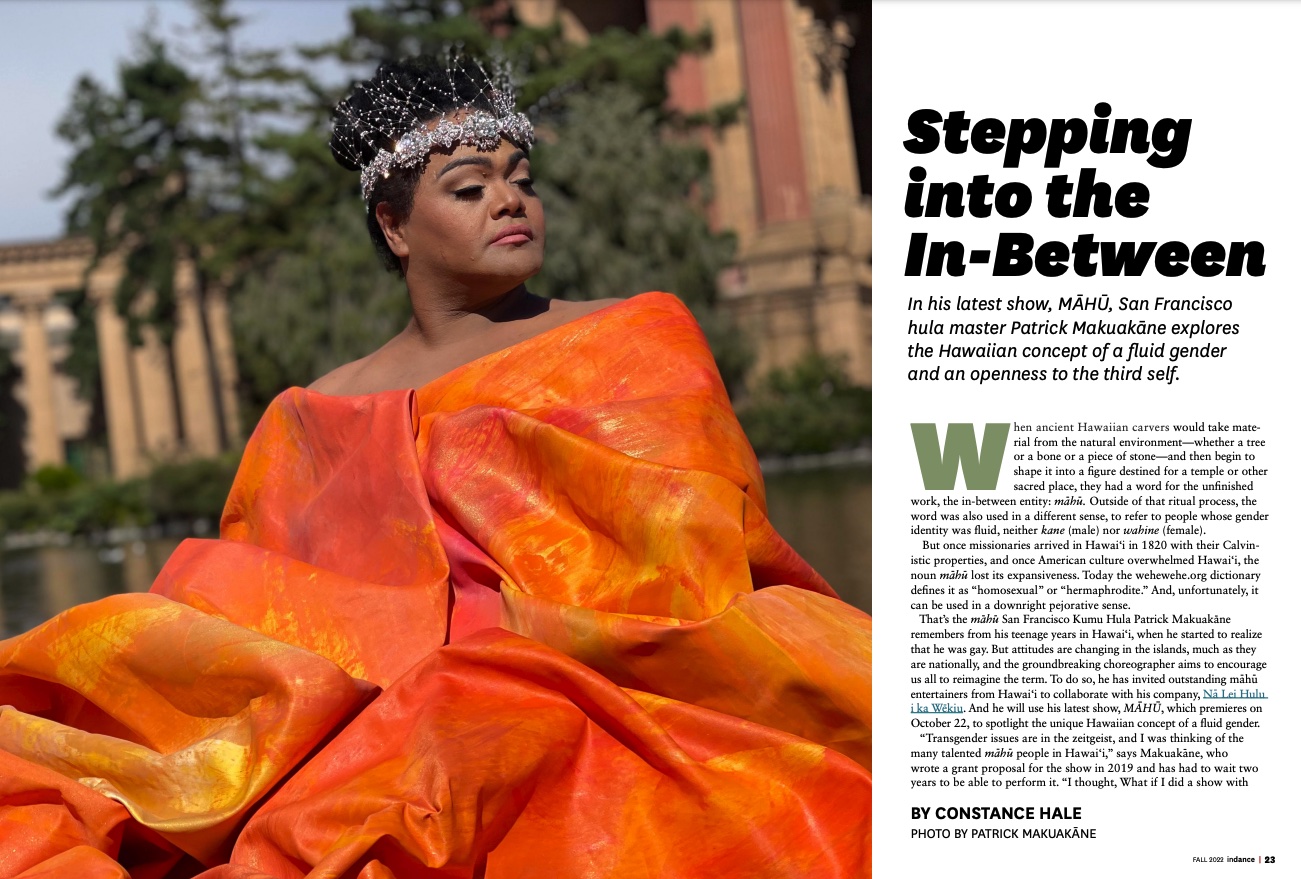
In his latest show, MĀHŪ, San Francisco hula master Patrick Makuakāne explores the Hawaiian concept of a fluid gender and an openness to the third self.
When ancient Hawaiian carvers would take material from the natural environment—whether a tree or a bone or a piece of stone—and then begin to shape it into a figure destined for a temple or other sacred place, they had a word for the unfinished work, the in-between entity: māhū. Outside of that ritual process, the word was also used in a different sense, to refer to people whose gender identity was fluid, neither kane (male) nor wahine (female).
But once missionaries arrived in Hawai‘i in 1820 with their Calvin- istic properties, and once American culture overwhelmed Hawai‘i, the noun māhū lost its expansiveness. Today the wehewehe.org dictionary defines it as “homosexual” or “hermaphrodite.” And, unfortunately, it can be used in a downright pejorative sense.
That’s the mahu San Francisco Kumu Hula Patrick Makuakāne remembers from his teenage years in Hawai‘i, when he started to realize that he was gay. But attitudes are changing in the islands, much as they are nationally, and the groundbreaking choreographer aims to encourage us all to reimagine the term. To do so, he has invited outstanding mahu entertainers from Hawai‘i to collaborate with his company, Nā Lei Hulu i ka Wēkiu. And he will use his latest show, MĀHŪ, which premieres on October 22, to spotlight the unique Hawaiian concept of a fluid gender.
“Transgender issues are in the zeitgeist, and I was thinking of the many talented mahu people in Hawai‘i,” says Makuakāne, who wrote a grant proposal for the show in 2019 and has had to wait two years to be able to perform it. “I thought, What if I did a show with transgendered artists who sang for us while we danced? I didn’t want to take a political stance, per se. I just wanted to let people hear them sing and watch them dance, because their artistry is so powerful.”
Yet Makuakāne acknowledges that celebrating such artists, and thereby celebrating the respect given to māhū people in ancient Hawaiian society, is inherently political. (There has never been a dance production or any kind of artistic showcase that has ever used that term in its name.) The show intends to move past the shame and ridicule that LGBTQ Hawaiians have endured by being labeled māhū. Instead it invites them to feel pride. Most important to him, though, is to “reclaim the idea of their authenticity and their humanity.”
The concept of a third gender, where individuals can express both their masculinity and femininity freely, is not unique to Hawai‘i. Parallels include hijra in Hindu society, Two-spirit Native Americans, the fakaleiti or fakafefine of Tonga, and the fa’afafine of Samoa.
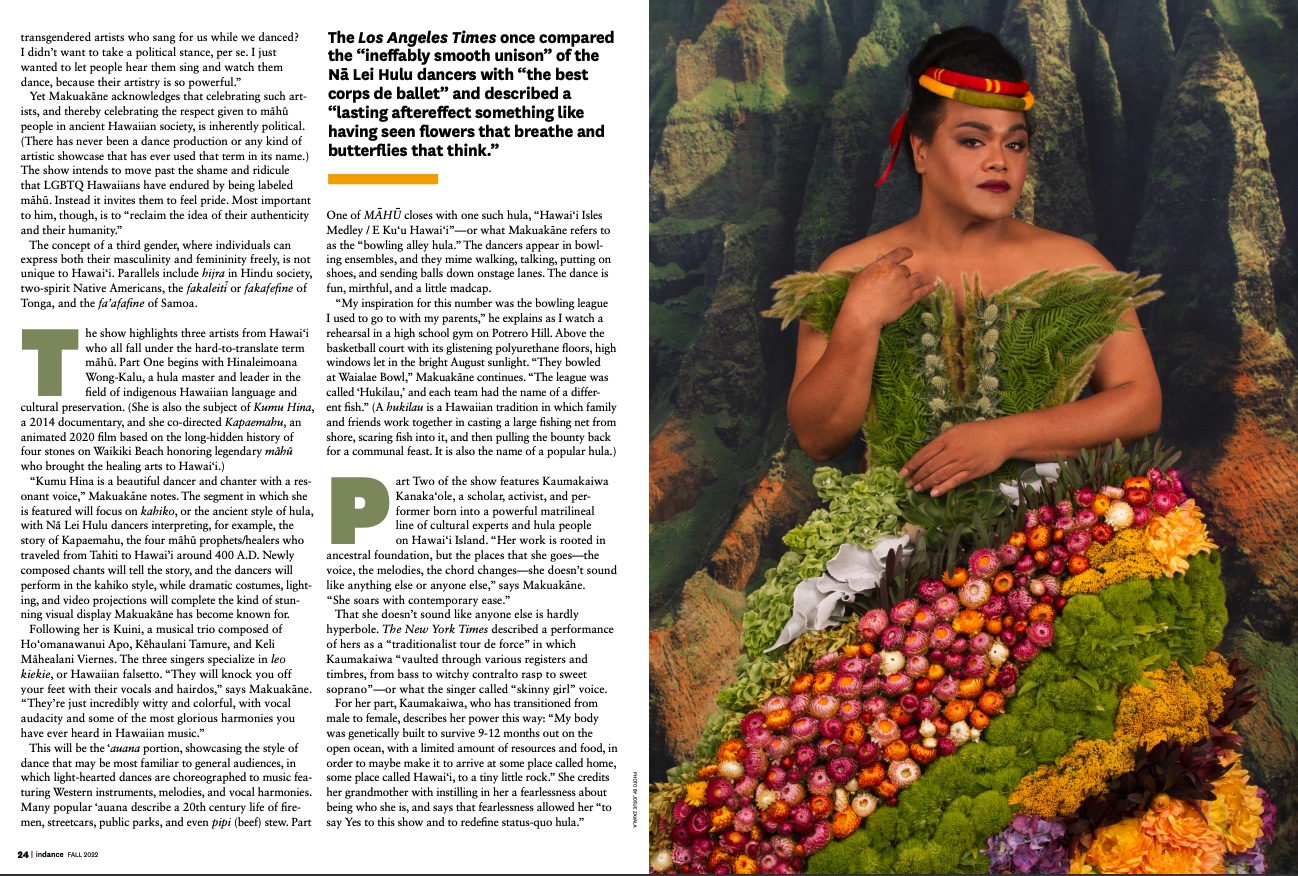
The show highlights three artists from Hawai‘i who all fall under the hard-to-translate term māhū. Part One begins with Hinaleimoana Wong-Kalu, a hula master and leader in the field of indigenous Hawaiian language and cultural preservation. (She is also the subject of Kumu Hina, a 2014 documentary, and she co-directed Kapaemahu, an animated 2020 film based on the long-hidden history of four stones on Waikiki Beach honoring legendary mahu who brought the healing arts to Hawai‘i.)
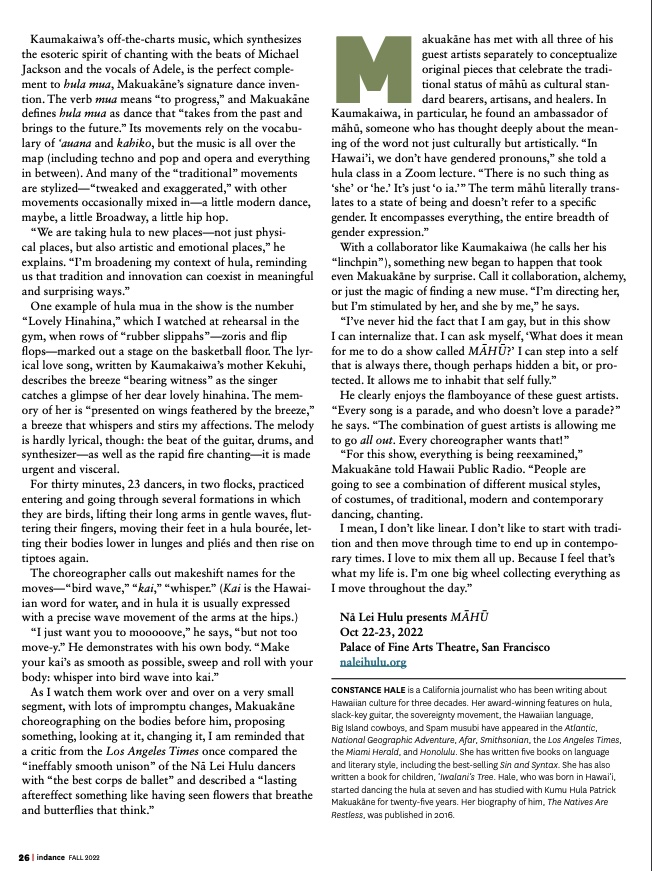
Kaumakaiwa’s off-the-charts music, which synthesizes Makuakāne has met with all three of his guest artists separately to conceptualize original pieces that celebrate the tradi- tional status of mahu as cultural stan- dard bearers, artisans, and healers. In Kaumakaiwa, in particular, he found an ambassador of mahu, someone who has thought deeply about the mean- ing of the word not just culturally but artistically. “In Hawai’i, we don’t have gendered pronouns,” she told a hula class in a Zoom lecture. “There is no such thing as ‘she’ or ‘he.’ It’s just ‘o ia.’” The term mahu literally trans- lates to a state of being and doesn’t refer to a specific gender. It encompasses everything, the entire breadth of gender expression.”
With a collaborator like Kaumakaiwa (he calls her his “linchpin”), something new began to happen that took even Makuakāne by surprise. Call it collaboration, alchemy, or just the magic of finding a new muse. “I’m directing her, but I’m stimulated by her, and she by me,” he says.
“I’ve never hid the fact that I am gay, but in this show I can internalize that. I can ask myself, ‘What does it mean for me to do a show called MĀHŪ?’ I can step into a self that is always there, though perhaps hidden a bit, or pro- tected. It allows me to inhabit that self fully.”
He clearly enjoys the flamboyance of these guest artists. “Every song is a parade, and who doesn’t love a parade?” he says. “The combination of guest artists is allowing me to go all out. Every choreographer wants that!”
“For this show, everything is being reexamined,” Makuakāne told Hawaii Public Radio. “People are going to see a combination of different musical styles, of costumes, of traditional, modern and contemporary dancing, chanting.
I mean, I don’t like linear. I don’t like to start with tradi- tion and then move through time to end up in contempo- rary times. I love to mix them all up. Because I feel that’s what my life is. I’m one big wheel collecting everything as I move throughout the day.”