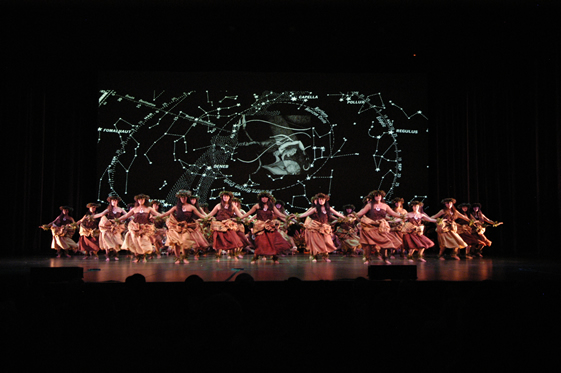
October 20 & 21, 26-28, 2012 | Palace of Fine Arts Theatre
from <'The Hula Show 2012' review: Sultry hip-hop SFGate.com
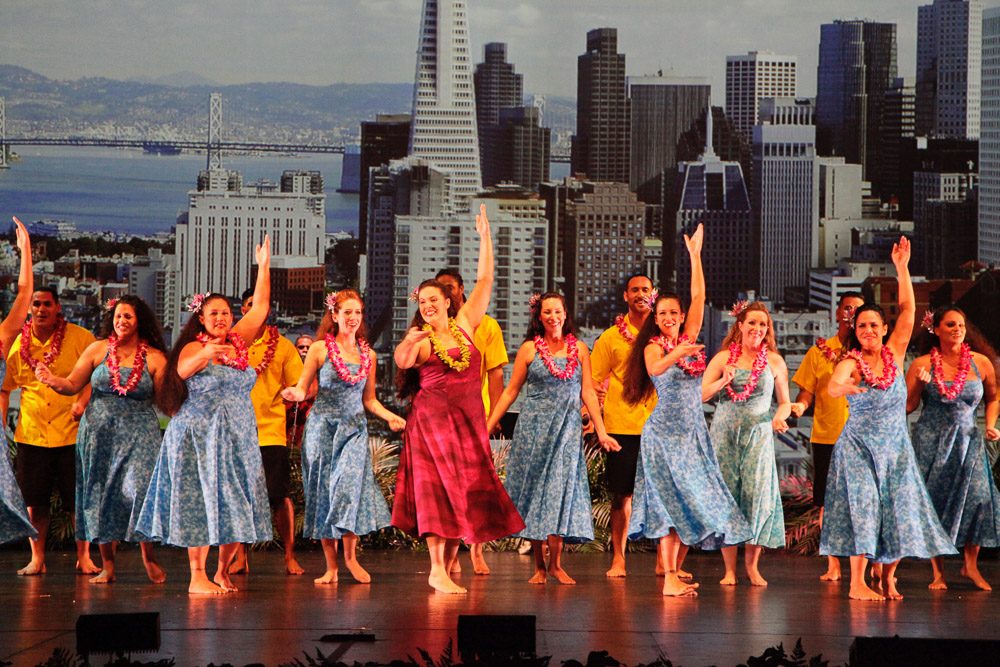
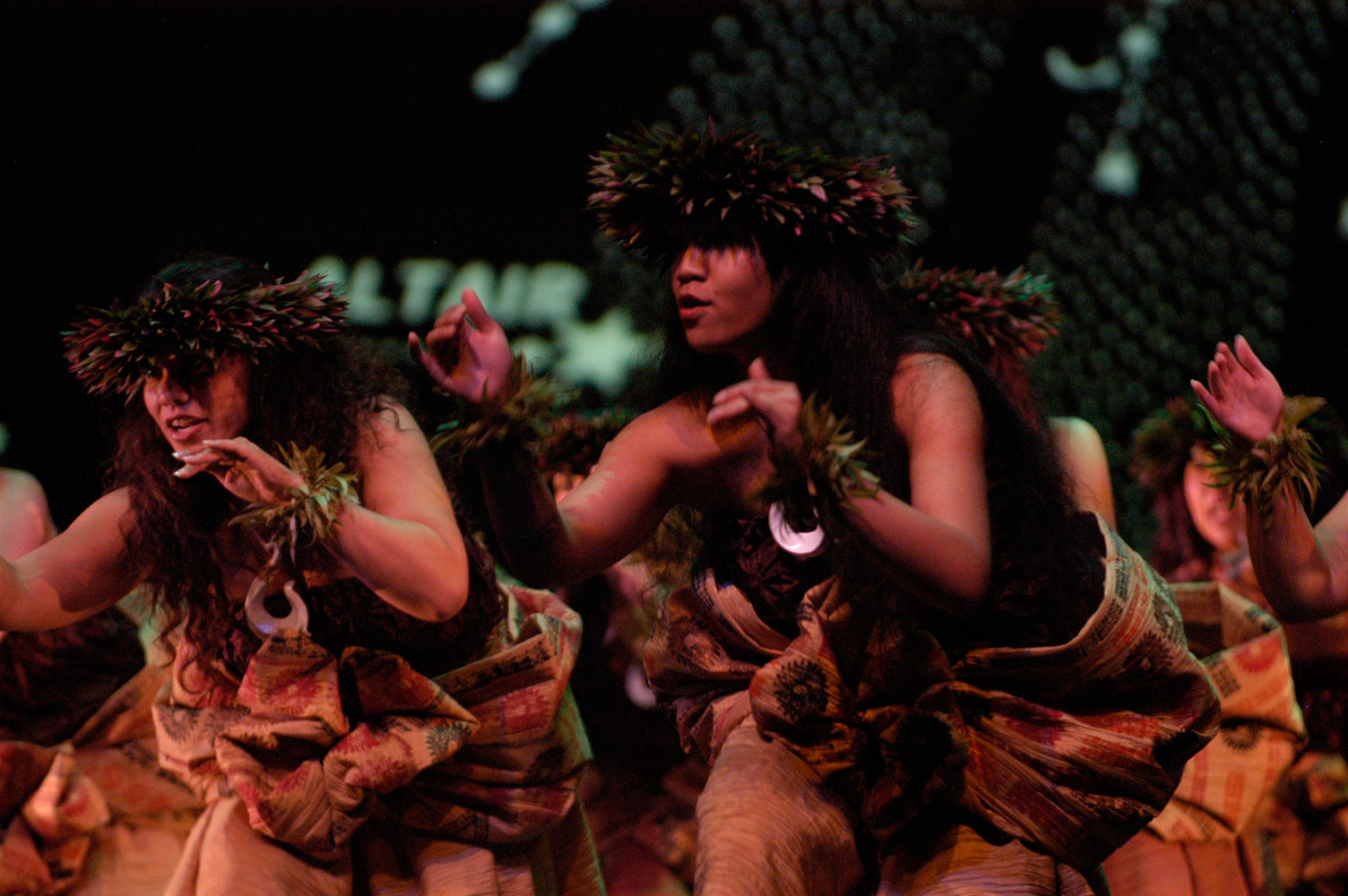
“The members of Makuakane’s halau, or hulu academy, tell their stories with remarkable simplicity, but perhaps most stirring is the demonstration of power from unison. A particularly impressive section for the women playing puili (split bamboo sticks) gives crisp definition to rhythmic structures on top of an eloquent rise and swell of movement. And in scenes that are oftentimes as earthy as they are beautiful, the 30 men and women of Na Lei Hulu revel in Makuakane’s sly humor.
In “Birth Certificate Hula,” a group of men with one woman dance a fast-paced satire to a song about the controversy surrounding Barack Obama’s birth certificate. Born in the same hospital as Obama and only weeks apart, Makuakane recounts with glee how he compared his birth certificate with the president’s. He found no irregularities.
On a more sultry note, Makuakane creates a sensual cross between hula and vogue for the women of the halau to Willis’ smoky cover of “Word Up.” The men take a grittier turn to the electronica of Faithless’ “Salva Mea.” Surprisingly, hula fits together with hip-hop moves seamlessly. Who knew that the downward pull of the hips and legs countered by an upward vector of the arms and eyes is both perfectly hula and perfectly hip-hop?
Guest Shawna Alapaʻi lent an elegant presence to two solos, and longtime Na Lei Hulu musicians Lihau Hannahs Paik on bass and Kellen Paik on guitar contributed lilting accompaniment.ʻ
October 15 & 16, 21-23, 2011 | Palace of Fine Arts Theatre
From review: Patrick Makuakane discusses Na Lei Hulu I Ka Wekiu (SFGate.com)
ʻWith a critical eye, Patrick Makuakane stands at a podium on stage and surveys 36 dancers standing in lines before him.
All belong to the performing troupe of his halau, Na Lei Hulu I Ka Wekiu, and they’re several hours into a daylong session of hula practice in the multipurpose gym at Daniel Webster Elementary in Potrero Hill.
There’s a faint scent of sweaty kids, floor wax and construction paper rather than plumeria or pikake. It’s mid-September, a month before they present their annual show at the Palace of Fine Arts. Slightly elevated on stage, Makuakane looks down at the dancers. He starts explaining what movements he wants – “bigger steps” – and demonstrates. The dancers watch. There are no questions. He steps behind a podium, and drums on it. He watches and stops the dancers. He demonstrates again and resumes his pounding. Then he watches. After the beat ceases he says:
“Much better. When I said ‘bigger steps,’ I didn’t mean bigger, sloppy steps.”
The dancers relax. Their teacher, or kumu, is pleased, and in this halau – as in any school for hula – the kumu rules absolutely.
Do the dancers ever push back? “No, no, no, no, no,” said Makuakane earlier in the week with an amused bark of a laugh. “You can’t say no to the kumu. You may have grumblings and go out with your hula brothers and hula sisters and say, ‘What is he doing?’ But you don’t say anything to him. It’s in the culture.”
Driven to dance
At a break in the Sunday session, a few dancers eat lunch in the schoolyard, cheerfully mocking themselves. “Yes, kumu,” chirps Maile Apau-Norris, 34, a workers’ compensation manager with a private insurance company who drives from Sacramento with three other dancers. “Yes, kumu,” pipes in Linda Zane, 44, a freelance graphic designer who comes in from the Peninsula with her 18-year-old daughter, Lehua, a student at the College of San Mateo who chimes in, “Yes, kumu.”
Giggly laughter bounces off the school’s walls. “We love our kumu, we love our kumu,” chants Janet Auwae-McCoy, sounding more like a singing Chipmunk than a 41-year-old analyst with the state Department of Toxic Substances Control. “We love our kumu.”
Makuakane, 50, understands the dedication that has the dancers practicing all day, every Sunday, at least 10 months of the year. “As a kumu, you are many things, brother, sister, mother, father. … They’re fully on board and they’re very trusting,” says Makuakane, who, as a young man in Honolulu, treated his kumu, Robert Cazimero, with the same respect.
Yet it was while dancing with Cazimero, a leading figure in the 1970s resurgence of Hawaiian culture and music, that Makuakane decided to “step it up.” He moved to San Francisco, where he graduated from San Francisco State with a physical education degree and launched a career as a personal trainer to support his hula habit.
“The most difficult thing about leaving Hawaii was leaving hula,” says Makuakane, who founded Na Lei Hulu I Ka Wekiu (“the many feathered wreaths at the summit, held in high esteem”) in 1985, the year he arrived in the city.
“When I first moved here and told people I was a hula teacher, the comments were unbelievable, and so inappropriate,” says Makuakane. “People were really incredulous. ‘Hula? And men do it?’ People thought you only saw it in hotels with dancers in coconut bras. They thought it was done to attract tourists – not that it was attached to the culture.
“I laugh about it now, but it was very frustrating in the early days,” says Makuakane. But even then, the Bay Area supported a hula network. News spread that a Cazimero dancer was teaching. It was like car-crazy kids learning the new drivers ed teacher had trained with Mario Andretti.
Today, Makuakane teaches hula full time, as he has for 10 years. Every two years, he starts a new class with 150 to 200 students. People enroll for many reasons. Some want to stay connected to home; others yearn for the Hawaii glimpsed as a visitor. Many seek a fitness routine.
“Then they realize it’s hard work. … They must learn language, the chants, learn the history, learn about the environment. It’s not just 5-6-7-8,” says Makuakane counting out a hula beat. “You’re learning why 5-6-7-8.”
Dedicated students
Slowly, students “remove themselves,” as he puts it.
The process reduces classes to 40 or 50 very dedicated people, from children to people in their 80s. They all learn movements that draw on “the natural environment, the breezes, the warmth of the sun, the land, the trees … and then you dress yourself with the greenery of the land,” says Makuakane.
“There’s a strong pull to the land. … That’s why there’s no leaping, we don’t spin too much. We stick close to the ground, to Mother Earth, to Haumea.”
Makuakane selects the creme de la creme of his students for the performance troupe. Among them are Jason Laskey, 34, an investment manager with Wells Fargo; his Honolulu K-12 schoolmate Jenny Des Jarlais, 34, an editor at BabyCenter.com; Ryan Fuimaono, 31, a social worker at Glide Community Housing; and Rose Guthrie, 21, a UC Berkeley senior who grew up on Potrero Hill. She’s an archaeology major, focusing on Hawaii.
The performing group, supported by students in the other classes, began putting on a really big show each autumn in 1996. It’s always a sellout, with the exception of 2008, the year the economy receded. Makuakane makes no apologies for choreographing to songs such Roberta Flack’s “The First Time Ever I Saw Your Face” because it gives new audience members a way in to more traditional works.
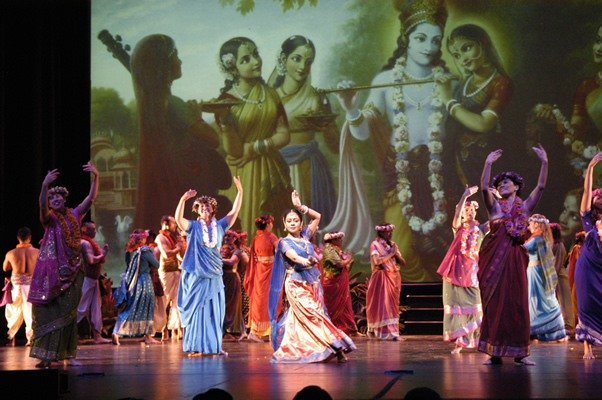
This year the show will present hula danced to music from India, Samoa, Turkey, Spain and Waianae. It includes Hanohano Kapalakiko, a suite of chants celebrating historical bonds between Hawaii and San Francisco.
“It is not traditional hula,” says Makuakane. “We execute a variety of dance styles; some of it is very modern. But the foundation for the movement is in hula vocabulary. The movement enhances the poetry; it’s all about embodying the mele (song or music), not overtaking the mele.”
Shift in direction
Makuakane credits Cazimero for pointing him toward nontraditional hula. “He raised many eyebrows experimenting, and that inspired me to try something different, to evolve hula. Hula mirrors your life. It’s different now than it was 200 years ago, it’s different in San Francisco from Hawaii.”
In 2003, Makuakane returned to Hawaii to study traditional hula with Mae Klein. In his 20s and 30s, Makuakane says he wanted hula to be exciting, but as an older dancer he could “see the pristine beauty in those dances. … It doesn’t need to be changed. Now, when I am choreographing difficult pieces, if I’m stuck, I’ll look to traditional dance and movement. It always seems to work.”
October 16-23, 2010 | Palace of Fine Arts Theatre
from Review: Na Lei Hulu I Ka Wekiu presents “25 Years of Hula” (StarkInsider.com)
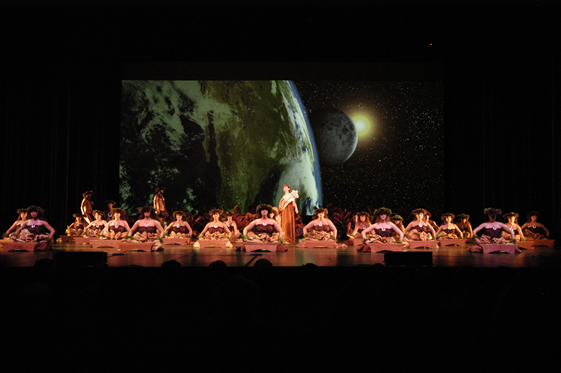
In honor of its 25th Anniversary, Kumu Hula Patrick Makuakāne and his award-winning dance troupe, Nā Lei Hulu I Ka Wēkiu, return to the Palace of Fine Arts Theatre for six performances only (October 16-24) with 25 Years of Hula, a retrospective that pays tribute to the company’s vast body of work. Featuring several of the most popular dance pieces from the past quarter of a century, Nā Lei Hulu I Ka Wēkiu will also feature a full-length version of the newly commissioned piece, “Kumulipo” – a series of dances inspired by the epic 2000-line Native Hawaiian creation chant that is nature’s song of origin. “Kumulipo” was commissioned by a 2010 Individual Artist Commission grant from the San Francisco Arts Commission.
Known for their trademark hula mua – which brings the ancient Hawaiian dance form into the modern realm by setting traditional hula movements to decidedly non-Hawaiian music resulting in a theatrical experience that is visually captivating and culturally rich – as well as hula kahiko – the traditional pre-Western style of Hawaiian dance – Nā Lei Hulu I Ka Wēkiu has garnered critical and audience acclaim throughout the San Francisco Bay Area and beyond. In 2006, Patrick Makuakāne was honored with the Malonga Casquelourd Lifetime Achievement Awards by World Arts West / San Francisco Ethnic Dance Festival for excellence in ethnic dance. Most recently, the troupe won an Isadora Duncan Dance Award (The Izzies) for Best Company for their performance of Roberta Flack’s “The First Time Ever I Saw Your Face” at the 2009 San Francisco Ethnic Dance Festival. The Izzies honor local dance artists and promote the diversity and vitality of the Bay Area dance community.
Among the pieces featured in 25 Years of Hula are “Hula’s Bar and Lei Stand,” a disco-inspired tribute to Honolulu’s most famous gay bar featuring Matthew Martin, one of San Francisco’s premier drag queens, “The Flower Duet” from the opera Lakme, in honor of King David Kalākaua, who was instrumental in reviving hula in the late 1800s after it had been banned by the missionaries and “Salva Mea,” Nā Lei Hulu’s iconic piece that reflects on the arrival of missionaries to early 19th century Hawaii.
25 Years of Hula will play six performances only at San Francisco’s Palace of Fine Arts (Bay & Lyon Streets). Performances are: Saturday, October 16 at 8 p.m., Sunday, October 17 at 3 p.m., Friday, October 22 at 8 p.m., Saturday, October 23 at 8 p.m. and Sunday, October 24 at 3 p.m. A one-hour family matinee designed especially for children and families is scheduled for Sunday, October 24 at 12 p.m. There will be an opening night champagne reception immediately following the performance on Saturday, October 16, as well as a gala benefit Lu’au and silent auction on Saturday, October 23 at 5:30 p.m.
MELE KUHIKUHI – SONG LIST
25 YEARS OF HULA
ACT ONE
Maikaʻi Ka ʻŌiwi O Kaʻala – traditional
ʻAuʻa ʻIa – traditional
Walk With Me – Moby, from the CD,album Wait for Me.
Lord'ʻs Prayer – traditional
Salva Mea – Faithless, from the CD single, "Salva Mea" (tuff mix).
pPost- production remix, Patrick Makuakāne.
The Flower Duet – Leo Delibes, from the oOpera, Lakmeé
He Aloha Nō ʻO Honolulu – Lot Kauwē
Aia I Waimanalo Kō Nuʻa Hulu – traditional
ʻAuhea Wale ʻOe E Ta Ua ʻUlalena – Nakulula
Aloha Ka Manini – Lot Kauwē
Hualālai – Dennis Kamakahi, from the CD, album Ka Pua Hae Hawaiʻi, by Nā Palapalai
Pāpālina Disco Megamix – Various artists, remixed by Patrick Makuakāane
History Repeating – The Propellerheads, featuring Shirley Bassey,
from the album CD, decksdrumsrockandroll
ACT TWO
Hānau Ka ʻUku Koʻakoʻa – traditional
Hānau Ka Iʻa – traditional
Hānau Ka Naonao – traditional
Hānau Ke Poʻo Waʻawaʻa – traditional
Ua Ao… Puka – Moby, from the CD single, "Go" (iIn dub mix).,
Post- production remix, Kris Kanoho.
Ka Pua Mohala – Puakea Nogelmeier
Every Time – Lustral
The First Time Ever I Saw Your Face – Ewan MacColl, from the album CD, Best of Roberta Flack
The Gift (2010 Remix) – Way Out West, 2010 remix. P post- production remix, Patrick Makuakāne.
O Ka ʻAu Moana – Lucia Tarallo Jensen
Manu ʻŌʻō – traditional
Wanting Memories / Maikaʻi Nā Pua – Sweet Honey in the Rock / Manu Boyd
Aia I Pōliko – Patrick Makuakāne
Love U More – Sunscreem/Patrick Makuakāne